Kriti Robertson is an independent business marketing consultant based in Hong Kong. She works with a small, capped roster of business owners who are tired of agencies that sell tactics before they have a strategy. Her work covers marketing strategy, organic SEO and a 14 day Local SEO Sprint for businesses that need customers now.
Marketing Audit: How I Find Where the Money Is Leaking Before Spending Another Dollar
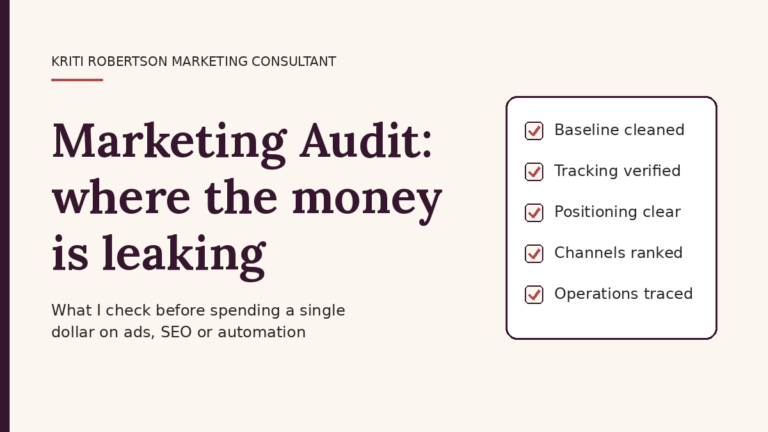
Most founders who contact me are not asking for a marketing audit. They are asking for more leads, or a new agency, or someone to “fix the ads.” But when I look at the account, the website, and the numbers behind them, the same thing is true almost every time: nobody has checked whether the current marketing is actually working before deciding to buy more of it. A marketing audit is the check. It is the one piece of work I will not skip, because everything I recommend afterwards rests on it. If the audit is wrong, the strategy is wrong, the budget is wrong, and the next twelve months are wrong by the same margin.
This post explains what a marketing audit is, what I look at, what I ignore, and why I insist on running one before I will put a single dollar behind a campaign. It is written for the two kinds of owners I work with most as a business marketing consultant: the established founder who has cycled through two or three agencies and still cannot say which channel is paying for itself, and the local operator who wants a straight answer on where the money is going.
What a marketing audit is, and what it is not
A marketing audit is a structured review of every part of your marketing that touches revenue: tracking, positioning, channels, content, the website journey, and the operations behind the sale. The output is not a 60-page PDF. It is a short list of the constraints that are actually holding growth back, ranked by how much they cost you, and a sequence for fixing them.
It is not a report on impressions. I do not care how many people saw an ad. I care how many of them became a lead, what that lead cost, and whether the lead was worth having. It is also not a channel review done in silos. The classic agency version of an audit is a Meta Ads specialist auditing Meta, an SEO team auditing SEO, and an email person auditing email, each producing a deck that recommends more of their own channel. That is not an audit. That is a sales pitch with a spreadsheet attached. The whole point of a marketing audit is to look across every channel at once and ask where the money leaks between them.
Why this matters more in 2026 than it did two years ago
Marketing budgets are not growing. The Gartner 2026 CMO Spend Survey, run across 401 marketing leaders between January and March 2026, found budgets sitting at 7.8% of company revenue, effectively flat on the 7.7% recorded in 2025. More telling: 56% of CMOs said their marketing organisation lacks the budget to deliver its 2026 strategy, and 54% said they lack the resources. Gartner’s own conclusion was that leaders now have to make “deliberate, data-driven trade-offs” about what to fund and what to cut.
Read that from a small business owner’s chair. If more than half of the companies with a full marketing department and a seven-figure budget cannot afford their own plan, the answer for a business with one marketer or none is not to spend more. It is to stop spending on the things that do not work. You cannot make that trade-off without knowing what is working, and you cannot know what is working without a marketing audit. Flat budgets make the audit the highest-return marketing activity you can do this year, because every dollar it moves from a dead channel to a live one is a dollar you did not have to find.
Step one: clean the baseline before you read it
Every audit I run starts with the data, and I do not take the analytics dashboard at face value. On one ecommerce account, the traffic numbers included a chunk of users from countries with no business reason to be visiting the site. It was almost certainly internal and team traffic inflating the real picture. The ad accounts were also billing in a different currency to the reporting currency, which would have skewed every cost-per-acquisition number if I had not converted it first.
Neither of those problems is exotic. I find some version of them in most accounts. If you build a 12-month plan on top of dirty numbers, every decision after that is wrong by the same margin. So before I judge a single channel, I check the basics: are internal visits filtered out, are currencies consistent, are conversion events firing once and only once, is the date range comparing like with like. Cleaning the data is not the boring part before the real work starts. It is the real work. Most agencies skip it because it does not produce a slide.
Step two: audit the tracking, not the creative
The second thing I check is what the platforms actually know about your customers. I audited a Meta Ads account that looked healthy on the surface: consistent spend, decent engagement, retargeting audiences already built. Then I opened the campaign objectives. Every one of them was reach, profile visits, or link clicks, and the pixel only tracked page views. Meta had no idea what a valuable customer looked like for this business, so it was optimising for attention instead of revenue. Busy is not the same as working.
This is why a proper marketing audit spends more time in the tracking settings than in the ad creative. Before I will launch ads for any ecommerce client, I make a test purchase on their website with my own card, end to end, to verify that add to cart, checkout initiated, and purchase all fire correctly. On the first run I usually find bugs. I hand the whole test to the developer and re-run it until every event passes. Those events are what teach the ad platforms who your buyers are. If tracking is broken, the algorithm learns from rubbish and you pay full price for the lesson. I would rather see a quiet ad account with three clean conversion events than a loud one with none.
Step three: audit the positioning, because rankings and clicks cannot fix a vague message
Once the numbers are trustworthy, I look at what you are actually saying. This is the part most audits ignore because it is hard to put in a chart, and it is usually where the biggest leak is. A page can rank first and still convert nobody if the visitor lands on it and has to decode what you do. A tailoring client of mine led every piece of marketing with the phrase “trunk show.” It is industry shorthand for the team travelling to a city for private fittings, but to a first-time international customer it means nothing. The fix was not more traffic. It was to say “we visit your city for private fittings” first, and introduce the insider term later.
I see this constantly. Businesses market in the language of people who already buy from them, not the language of people they are trying to convert. So the audit checks the homepage, the top three service pages, and the top three ads against one question: would a stranger with a problem understand, in ten seconds, what you solve and why you rather than the next result. If the answer is no, every channel downstream is paying a tax on that confusion, and no amount of small business seo services or ad spend will refund it.
Step four: audit the channels, in order of what they cost you
Only now do I go channel by channel, and I go in order of spend. Paid first, because it burns fastest. Then organic search, because it compounds and the mistakes there are usually structural: the wrong pages targeting the wrong intent, thin service pages, no internal links, a blog writing beautifully optimised articles for keywords that twenty people a month search for. Then email and automation, because this is where most businesses have the cheapest unclaimed revenue. Then social, which I audit last and judge differently. With a small following nobody finds you through your Instagram page. They find you through ads, Google, or a PR mention and then check your Instagram to answer one question: are you a real brand or not. So I judge organic social by what a suspicious first-time visitor would conclude in ten seconds, not by reach.
For local businesses there is one more channel that gets audited on its own, and it is the one owners most often assume is fine. I scored one client’s Google Business Profile and their reviews came out excellent: high volume, strong ratings, genuinely good. Then I scored the rest of the profile. Wrong category, no posts, no products, photos two to six years old, zero keyword alignment. Total score: 26 out of 60. Reviews build trust once someone is already looking at you. They do nothing to help someone find you in the first place. That gap is the whole reason I run a fixed-fee 14-day intensive as a local seo consultant, and it is the single most common finding in audits for brick-and-mortar businesses.
Step five: audit the operations behind the marketing
This is the step that separates a marketing audit from a channel review. One client came to me wanting marketing help. Once I looked closer, their real problem was operations: broken links throughout the customer journey, too many manual processes, systems that did not talk to each other. I could have ignored it and run campaigns. Instead I told them plainly that marketing alone would not solve it, flagged the operational bottlenecks for them to fix, and built the marketing system in parallel so that when demand arrived the business could handle it.
Marketing accelerates growth, but it also accelerates problems. If the follow-up process is broken, great marketing just helps more people experience the broken follow-up. So the audit traces one lead all the way through: form fill, notification, first reply, booking, proposal, close, and what happens to the ones who say no. Most of the time the fix is a connected system rather than a new campaign, which is work I do as a marketing automation specialist rather than a media buyer. An email marketing consultant who cannot see your CRM is auditing half the funnel.
What comes out of a marketing audit
The deliverable is deliberately short. A ranked list of constraints, a plain-English explanation of what each one is costing, and a sequence. I structure that sequence the same way on almost every project: Fix, Focus, Grow. Fix in months one and two, meaning tracking, the catalogue or service pages, and the basic conversion mechanics. Focus in months two to four, meaning own the one search intent or audience the data already proves is converting. Only then Grow. I also set a hard rule alongside it: pause any ad spend that cannot beat a calculated breakeven cost-per-acquisition. No exceptions, no “give it one more week.” Scaling a broken funnel gets you a bigger broken funnel, faster.
Clients almost always want to talk about scaling first. More spend, more content, more channels. The audit is what earns me the right to say no to that, because I can show them, in their own numbers, where the leak is and what it costs per month to leave it open. That evidence is also why sceptical clients, the ones who arrived burnt out from two or three agencies, end up being the easiest to work with. Every recommendation is based on research and numbers rather than a hunch, and scepticism built on bad experiences dissolves fast when the work is evidence-based.
How to do a marketing audit yourself, if you are not ready to hire one
If you are a bootstrapped operator and a consultant is not in the budget yet, you can run a lean version of this in a weekend. Pull the last 90 days of spend by channel and write down, next to each one, how many leads or sales you can prove it produced. Not clicks. Leads. Where the answer is “I do not know,” that is your first finding. Then open your ad accounts and check the campaign objective and the conversion events. If the objective is traffic and the pixel only tracks page views, stop the campaign until that is fixed. Then read your own homepage as a stranger and time how long it takes to understand what you sell. Then search your business on Google and score the profile honestly: category, photos, posts, products, services. Then fill in your own contact form and watch what happens. Those five checks will not replace a full audit, but they will find the biggest leak in most small businesses, and the productised versions of the exact scoring sheets and trackers I use for this sit in my Template Shop for owners who want the framework without the retainer.
When to bring in a consultant instead
Bring in help when the numbers disagree with each other, when you have already tried two agencies and still cannot name your cost per lead, or when the audit needs to cover paid, organic, and automation together. That last one matters. Auditing channels separately is how you end up with three specialists each recommending their own channel. The value of working with a full stack digital marketing consultant is that the same person checks the ad tracking, the search structure, and the email flows, so the findings connect. It is the difference between a set of opinions and a diagnosis.
At Kriti Robertson Marketing Consultant, the audit is where every engagement starts, whether that is the full retainer or a one-off marketing strategy consultant project. It is also the reason KRMC caps retainers at three clients. An audit done properly takes real hours in real accounts, and it cannot be delegated to a junior account manager and a template. If you have been spending on marketing for more than six months and cannot say, with numbers, which part of it is paying for itself, that is the audit telling you it is overdue. I will audit your funnel in week one and tell you exactly where the leaks are. The strategy comes after, and it will be better for it.