How to Build an Automation Strategy That Fixes the Right Problem First
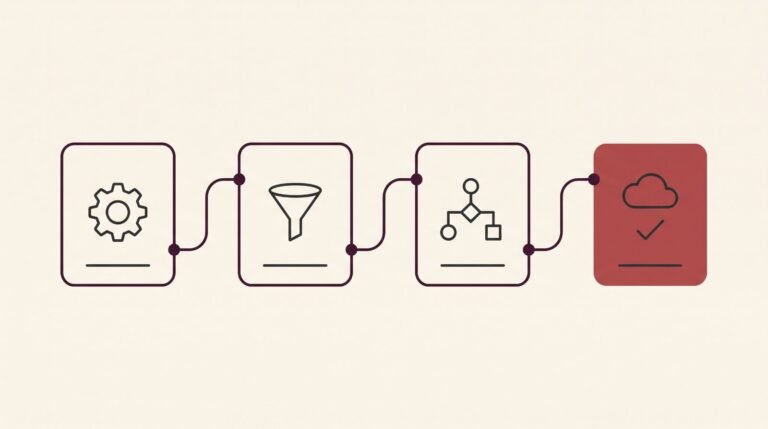
Most people ask how to build an automation strategy the moment they get excited about a tool. They have seen a demo, watched a competitor move faster, or read that automation saves money, and now they want a list of things to plug in. I understand the instinct. I also think it is backwards. An automation strategy is not a shopping list of software. It is a decision about which problem in your business is quietly costing you the most, and whether removing the manual work around that problem will actually move a number that matters. Get that decision right and the tools are almost an afterthought. Get it wrong and you have just made a broken process run faster.
I want to walk through how I build an automation strategy for the businesses I work with, because the order I do things in is the whole point. This is not theory. It is the sequence I have watched separate the businesses that get real returns from the ones that spend a year connecting apps and end up more confused than when they started.
Why most automation strategies fail before they start
The failure is almost always the same: tool first, thinking second. Someone buys the automation platform, then goes looking for things to automate. The result is a pile of half-connected workflows that impress nobody and save no meaningful time.
The data backs this up. Forrester found that 82% of organizations still rely on manual, paper-based routing of tasks supported by spreadsheets, despite years of automation being available and affordable (FlowForma, Business Process Automation Statistics). The tools have been here for a long time. The reason so much manual work survives is not access. It is that most businesses never sat down and decided what to automate and why. Tellingly, when PEX Network surveyed operational leaders, one of the top three barriers to transformation was not budget or software at all, it was linking process improvement to top-level business strategy. In other words, the hard part is not the automation. It is knowing what deserves it.
That is the difference between buying a tool and having a strategy. A tool answers “how.” A strategy answers “what” and “why first.”
Start with the constraint, not the software
I do not start with marketing, and I do not start with automation either. I start by finding the biggest constraint to growth, then I decide whether automation is part of removing it.
One client came to me wanting marketing help. Once I looked closer, their real problem was not demand at all. It was operations. There were broken links throughout the customer journey, too many manual processes, and systems that did not talk to each other. I could have ignored all of that and just run campaigns, which is what most people in my position do because campaigns are what they were hired for. Instead I was upfront with them: marketing alone would not solve this. I flagged the operational bottlenecks for them to fix while I built their marketing system from the ground up, so we were not just generating more demand, we were preparing the business to actually handle it.
Here is the principle I took from that, and it applies directly to automation: marketing accelerates growth, but it also accelerates problems. Automation is exactly the same. If a process is broken, automating it does not fix it. It just helps more people experience the broken version, faster and at scale. So before you automate anything, you have to be honest about whether the underlying process is worth speeding up. That is why the first step of building an automation strategy has nothing to do with automation. It is a diagnosis.
Step one: map every manual process and every place your systems do not talk
Write down every repetitive task that a human touches in your business. Every lead that gets copied from one place to another by hand. Every invoice chased manually. Every spreadsheet someone updates on a Friday because two tools refuse to share data. Every follow-up email typed from scratch that could have been typed once.
Then, next to each one, note two things: how long it takes per week, and what breaks when the person responsible is on holiday or leaves. That second column matters more than people expect. A process that only works because one specific person remembers to do it is not a process, it is a risk. Those are often the highest-value things to automate, not because they eat the most hours, but because they are the most fragile.
This map is your raw material. Do not automate a single thing until it exists, because without it you are guessing, and guessing is how businesses end up automating the easy, visible tasks while the expensive, invisible ones keep leaking money.
Step two: rank by the cost of the leak, not the ease of the fix
This is where most automation strategies go quietly wrong. People sort their list by what is easiest to automate. That feels productive. You get quick wins, you connect a few apps, you feel modern. But easy and valuable are rarely the same thing.
Rank your list instead by the cost of leaving it manual. What is the real price of that task staying the way it is, in hours, in errors, in leads that go cold, in customers who slip through a gap between two systems? Automate in that order. A workflow that recovers three lost leads a month is worth more than ten workflows that each shave two minutes off an admin task nobody minds doing.
When I build a growth roadmap I structure it in deliberate phases: fix first, then focus, then grow. Automation belongs in that same discipline. Fix the process, prove it works manually, and only then automate it so the fix scales. Automating before the fix is proven just gets you a bigger broken funnel, faster.
Step three: clean the data before you build anything on top of it
Automation runs on data, and it trusts whatever data you give it completely. That is the danger. Before I build a strategy of any kind, I build a baseline, and I do not take the numbers at face value. On one account, the traffic reporting was inflated by a chunk of users from countries with no business reason to be there, almost certainly internal team traffic. On another, the ad spend was billed in a different currency to the reporting, which would have thrown off every cost figure if I had not converted it first.
If you build a twelve-month plan on top of dirty numbers, every decision after that is wrong by the same margin. Automation makes this worse, not better, because it removes the human who might have noticed the number looked off. So before you connect systems together, make sure the data flowing between them is clean. Cleaning the data is not the boring part before the real work starts. It is the real work.
Step four: automate one workflow end to end before you scale
Once you know your priority and your data is clean, resist the urge to automate everything at once. Take your single highest-value workflow and build it properly, from the first trigger to the final outcome, and test it as if you were the customer moving through it.
I do a version of this before I ever spend money on ads: I make a real purchase on the client’s own website, end to end, with my own card, to verify every tracking event actually fires. On the first run I almost always find something broken. Apply the same standard to an automation. Run a real record all the way through the workflow and watch what happens at every handoff. If a lead comes in, does it land in the right place, tagged correctly, with the follow-up actually sending? Do not assume. Check. One clean, fully working automation you trust is worth more than ten you half-built and now quietly do not rely on.
This is also where a good marketing automation specialist earns their keep, because the failures in automation almost never happen inside a single tool. They happen in the seams between tools, exactly the place a demo never shows you.
Step five: keep a human on the parts that carry your brand
Automation should handle the mechanical, repetitive, judgment-free work. It should not be allowed to become the voice of your business. I have firm rules about this with AI content, and the same logic applies to any automation that touches a customer. Use it for speed, never for the soul.
Nothing goes out on autopilot without a human having shaped it first. An automated welcome sequence is fine, as long as a person wrote it, gave it real personality, and checks that it still sounds like you. The moment a customer can tell they are talking to a machine that clearly does not know or care who they are, the efficiency you gained is costing you trust, and trust is far more expensive to rebuild than time is to save. Automate the plumbing. Keep your hands on anything a customer will read, hear, or feel.
How to build an automation strategy that actually lasts
Pulled together, this is how to build an automation strategy that actually earns its place: it is not a technical exercise, it is a prioritisation exercise with software attached at the end. You map the manual work, you rank it by the cost of the leak, you clean the data underneath it, you build and genuinely test one workflow at a time, and you keep a human on everything that carries your name. Do that and automation becomes what it should be: a quiet system that removes friction and gives you back hours, rather than another dashboard you have to babysit.
It is worth doing well. When automation is targeted at the right problem, the returns are real, and every serious study of adoption points the same way. But the businesses seeing those returns are not the ones who bought the most tools. They are the ones who decided, before they bought anything, what deserved automating and why.
If you are not sure where your biggest leak actually is, that is the honest place to start, and it is the same place I start with every client. I diagnose the business first, then I decide what to automate, then I build. If you want help doing that in the right order, that is what I do as a business marketing consultant, and it is the thinking behind my marketing strategy consultant work: find the constraint, fix it, then let systems carry it. The tools will still be there when you are ready. The clarity is the part worth building first.