Kriti Robertson is an independent business marketing consultant based in Hong Kong. She works with a small, capped roster of business owners who are tired of agencies that sell tactics before they have a strategy. Her work covers marketing strategy, organic SEO and a 14 day Local SEO Sprint for businesses that need customers now.
Fractional CMO Cost in 2026: What You Pay, What You Get, and When It Is Worth It
The short answer on fractional CMO cost
Fractional CMO cost in 2026 sits between $4,000 and $20,000 a month for most engagements, with hourly arrangements running $150 to $500 (Go Fractional, 2026). That is the market range. It is also close to useless on its own, because the number you pay tells you nothing about what you get for it.
I am Kriti Robertson, and I run Kriti Robertson Marketing Consultant (KRMC), a full-stack consultancy where I hold the strategy, the paid media, the SEO and the automation for a maximum of three retainer clients at a time. Founders ask me about fractional CMO cost almost weekly, usually after they have already paid an agency for a year and cannot point to a single number that improved. So this post does two things. It gives you the real cost brackets and what sits behind them. Then it gives you the questions that separate a fractional CMO who moves pipeline from one who produces slide decks.
What full-time leadership actually costs
Start with the alternative, because that is the only honest comparison. Salary.com puts the average chief marketing officer salary in the United States at $374,184 a year as of September 2026, with the middle half of the market earning between $335,641 and $417,860. That is base salary. Add bonus, equity, benefits and the team a full-time CMO will insist on hiring in their first quarter, and the fully loaded cost for a business doing under $20 million a year is rarely below $500,000.
Now hold that against the budget most companies actually have. Gartner’s 2025 CMO Spend Survey found marketing budgets flat at 7.7 percent of company revenue, with 59 percent of CMOs reporting they do not have enough budget to execute their strategy. For a $5 million business, 7.7 percent is $385,000 for everything: media, tools, content, people. A full-time CMO would consume the entire budget before a single ad ran.
That is the arithmetic behind the fractional model. It is not a discount version of a CMO, and it is a different thing again from a part time CMO or an outsourced CMO arrangement. It is senior marketing leadership sized to a budget where a full-time executive does not fit.
The three cost brackets, and what each one buys
I have watched enough engagements from the inside to know the brackets are real, and that price mostly tracks two things: how many hours you get, and whether the person executes or only advises.
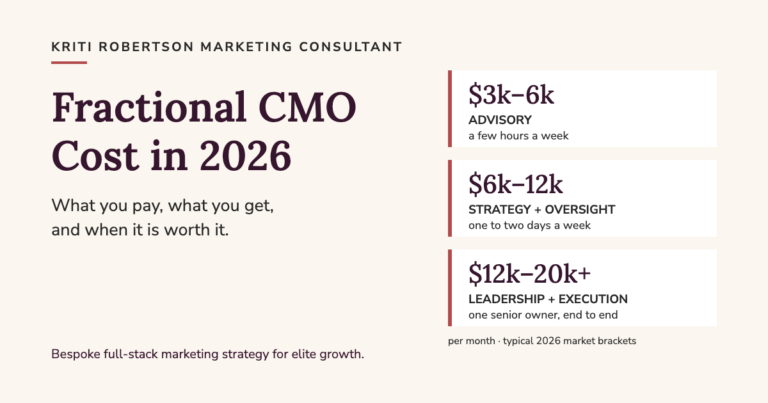
$3,000 to $6,000 a month. This is advisory. You get a few hours a week, a monthly strategy call, feedback on your plans and a person to phone when a decision is bigger than your team. Nobody in this bracket is building your Meta campaigns or fixing your conversion tracking. If your team can execute and just needs direction, this bracket can work. If you have no team, you are paying for advice nobody will implement.
$6,000 to $12,000 a month. This is the strategy-plus-oversight bracket, and it is where most fractional CMO engagements land. Expect one to two days a week, ownership of the marketing plan, management of your agencies and freelancers, and reporting to you or the board. The person is accountable for outcomes but still relies on other hands for the work. The quality of those other hands decides whether the money is well spent.
$12,000 to $20,000 a month and above. This is leadership plus execution. The fractional CMO either brings a team or is a full stack digital marketing consultant who does the work directly. Fewer handoffs, faster changes, and one person who is responsible when a campaign underperforms. It costs more per month and usually costs less per result, because nothing gets lost between the strategy document and the ad account.
Hourly pricing exists across all three, but I would not buy it. Hourly rates reward slow work and discourage the quick five-minute fix. A fixed monthly scope with defined outputs is what you want.
Why fractional CMO cost varies so much between two people with the same title
Two fractional CMOs can quote $8,000 a month and deliver completely different things. The title is unregulated. Anyone with a LinkedIn profile can use it, and the same person might call themselves a strategic marketing consultant one month and a freelance marketing consultant the next. When I look at why the same price produces such different results, it comes down to four variables.
Scope of channels. A marketing strategy consultant who owns paid, organic and lifecycle together can see the whole funnel. Someone who only knows paid social will fix paid social and call it strategy.
Execution versus delegation. Ask who actually logs into the ad account. If the answer is “my team” or “your agency”, the fractional CMO is a manager, and you are paying management fees on top of execution fees.
Client load. A fractional CMO with twelve clients gives you a twelfth of their attention. I cap my Full-Stack Strategic Retainer at three clients for exactly this reason. It is the only way one person can hold the strategy and the execution for a business without either one slipping.
Measurement discipline. This is the one most founders skip when they compare quotes. A fractional CMO who reports on reach, followers and clicks is cheaper for a reason. Pipeline, cost per qualified lead and payback period are harder to report and harder to hide behind.
What I learned from the client who wanted advice, not execution
When I started KRMC, I sold a clarity session. I would help a founder work out their positioning, give them a strategy, and they would go and implement it themselves. It was cheap, it was clean, and it did not work. Every conversation ended the same way. The owner was too busy running the business to think about marketing, let alone execute it. They did not want guidance. They wanted someone they could trust to take the whole thing and do it properly.
So I rebuilt the business around done-for-you strategy plus implementation, and I stopped pretending the cheaper advisory model was a kindness. It was a way of charging less for something that would not produce results. If you are comparing fractional CMO cost right now and the cheapest option is advice only, ask yourself honestly who on your team will do the work. If the answer is nobody, that option is not cheaper. It is just smaller.
The hidden costs that never appear on the proposal
The monthly fee is the visible cost. Three other costs decide whether the engagement pays for itself.
The first is the agency layer underneath. Gartner found 39 percent of CMOs plan to cut agency budgets in 2025, and I understand why. A fractional CMO who manages an agency for you still leaves you paying for a junior account manager, a channel silo and a monthly PDF that reads well and changes nothing. If the fractional model does not remove that layer, you have added a cost, not replaced one.
The second is time to impact. A fractional CMO on one day a week takes longer to reach the same milestones as one on three. That is fine if you plan for it. It is expensive if you expected month-two results from a month-one budget.
The third is tracking. This is where I am blunt with every new client. Clients almost always want to talk about scaling first: more spend, more content, more channels. I will not propose scaling before I propose fixing measurement. My roadmaps run in three phases. Fix in months one and two, meaning conversion tracking, catalogue, and basic funnel mechanics. Focus in months two to four, meaning owning the one search intent or audience the data already proves converts. Then Grow. Scaling a broken funnel gets you a bigger broken funnel, faster. Any fractional CMO who proposes spend before they have audited your tracking is charging you to guess.
When fractional CMO cost is worth paying
It is worth it when three things are true at once.
You have a product that already sells. Fractional leadership accelerates something that works. It does not rescue a product nobody wants.
You are spending, or ready to spend, at least $5,000 a month on marketing beyond the fee. Below that, a senior strategist is optimising a budget too small to move, and a fixed-scope project such as a local SEO consultant sprint or a template-driven plan will get you further for less.
You have no senior marketer in the building. If you already employ a capable head of marketing, a fractional CMO duplicates them. Spend the money on a specialist instead: an organic SEO consultant to fix your search visibility, or a marketing automation specialist to build the lifecycle emails your team has been putting off for a year.
Spencer Stuart’s CMO Tenure Study put the average Fortune 500 CMO tenure at 4.3 years, and only 66 percent of those companies had a C-suite marketing leader at all. Even the largest businesses in the world are hesitant about the full-time role. For a founder-led company, the fractional route is not a compromise. It is the version of the role that matches your stage.
How I price it, and why
I am a business marketing consultant, not an agency, and I price like one. My Full-Stack Strategic Retainer is a fixed monthly fee for one person who owns Meta ads, SEO and AI automation end to end, capped at three clients. There is no account manager between us. When you email, I answer, and the person answering is the person who built the campaign.
For founders who are not at retainer stage, I have two smaller doors. The Local SEO Sprint is a fixed-fee, 14-day Google Business Profile intensive with four slots a month, built for brick-and-mortar operators who need results before they need a strategy deck. The Template Shop sells the SOPs, dashboards and frameworks I use with retainer clients, for businesses that want the system without the person.
Whether you work with me or not, that is the structure I would look for: growth strategy consulting and execution from the same senior person, a client cap you can verify, and a measurement plan that shows up before the media plan does.
Five questions that expose the real value behind the fee
Before you sign anything, ask these, in this order.
Who logs into the ad accounts and the analytics, and how often. If it is not the fractional CMO, ask what you are paying them for.
What is the first thing you will do in week one. The right answer involves tracking, baselines and a funnel audit. The wrong answer involves a brand workshop.
How many clients do you hold at once. Get a number. Anything above six and your Tuesday problem waits until the following Tuesday.
Which three numbers will you report on monthly. If clicks, impressions or followers are in the list, keep looking.
What happens to my agencies. A strong fractional CMO will tell you which vendors stay, which go, and what that saves you. That saving is usually where a good part of the fee comes from.
Fractional CMO cost is a fair question, and the honest answer is a range, not a number. But the range only matters once you know what sits behind the price. Get the scope, the seniority and the measurement right, and the fee becomes the smallest number in the conversation. Get them wrong and no price is cheap enough.
Sources: Go Fractional, “Fractional CMO Cost: 2026 Rates by Engagement Type” (2026); Salary.com, Chief Marketing Officer salary benchmark (September 2026); Gartner, 2025 CMO Spend Survey (May 2025); Spencer Stuart, CMO Tenure Study 2025.