Kriti Robertson is an independent business marketing consultant based in Hong Kong. She works with a small, capped roster of business owners who are tired of agencies that sell tactics before they have a strategy. Her work covers marketing strategy, organic SEO and a 14 day Local SEO Sprint for businesses that need customers now.
Fractional CMO vs Full Time CMO: 5 Questions That Decide the Hire
Fractional CMO vs full time CMO: the short answer
The fractional CMO vs full time CMO decision is not about which title sounds more serious. It is about how much marketing leadership your business can absorb right now, and what it costs you to be wrong. Here is my verdict up front. If you are under roughly $10 million in revenue, hire fractional. If marketing is a department of ten or more people that needs daily management, hire full time. Most founders who ask me this question are in the first group and are being sold the second.
I should declare my bias. I am the fractional option. I run Kriti Robertson Marketing Consultant as a senior, one-woman consultancy, so I sit on one side of this comparison. I will still tell you where a full-time hire wins, because it does, and because taking on a client who needs a full-time executive wastes their time and their money.
What each role actually is
Before comparing fractional CMO vs full time CMO on cost, be clear about what you are buying in each case.
A full time CMO is an employee. One salary, one company, forty-plus hours a week. They sit in the leadership meeting, manage the marketing team, own the budget, and answer to the CEO and the board. You are buying presence and people management as much as strategy.
A fractional CMO is the same seniority on a part-time contract. Typically ten to twenty hours a week, on a monthly retainer, with a notice period measured in weeks. They set the strategy, pick the channels, own the numbers, and either direct your existing team or bring the execution with them. I have written separately about how a part time CMO works day to day, and what an outsourced CMO should be accountable for.
Same job description on paper. Very different cost, speed and risk.
The cost gap, in real numbers
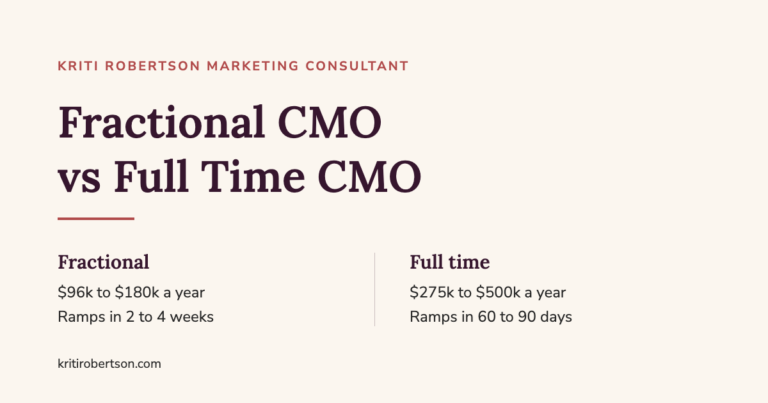
A full time CMO in the US carries total compensation of roughly $275,000 to $500,000 a year once you add bonus, benefits and equity to the base. A fractional CMO retainer typically runs $8,000 to $15,000 a month, which is $96,000 to $180,000 a year. For context on how senior marketing help is priced more broadly, see my breakdown of what a marketing consultant costs.
Those numbers mean nothing until you put them next to your budget. Gartner’s 2026 CMO Spend Survey of 401 marketing leaders found that marketing budgets sit at 7.8% of company revenue this year, and that 56% of CMOs say their budget cannot fund their 2026 strategy (Gartner, May 2026).
Run the maths on that benchmark.
- $3 million in revenue: a 7.8% marketing budget is $234,000. A full time CMO at $300,000 costs more than the entire budget. There is nothing left for ads, content or tools.
- $10 million in revenue: the budget is $780,000. A $300,000 executive takes 38% of it before a single campaign runs.
- $30 million in revenue: the budget is $2.34 million. The same salary is 13%. Now it is a reasonable line item.
This is where the fractional CMO vs full time CMO comparison gets decided for most small businesses, and it is the bottom-line logic most hiring conversations skip. Leadership should be a small share of the budget so that most of the money goes into the market. Below $10 million, a full-time executive flips that ratio. You end up with an expensive strategist and no money to execute the strategy.
The tenure problem nobody budgets for
There is a second cost. Spencer Stuart data puts the average CMO tenure at S&P 500 companies at 4.1 years, the shortest of any core C-suite role (reported by MarketScale, August 2026). Those are large companies with established brands and proper onboarding. In a founder-led business the fit is harder and the runway is shorter.
Think about what a short tenure really costs. Months to run the search. Sixty to ninety days before a new executive is making confident decisions. Then, if it does not work out, a notice period, a severance conversation, and a strategy that leaves the building with them.
A fractional CMO typically ramps in two to four weeks, and if it is not working you end the contract on short notice. The downside is capped. I would rather a client found out in month two that we are a poor fit than in month fourteen.
5 questions that decide fractional CMO vs full time CMO
When a founder asks me which way to go, I ask these five questions. The answers usually settle it within ten minutes.
1. How big is the team that needs managing?
If you have one or two marketers, or a few freelancers, there is not forty hours of leadership work in the week. A full time CMO will fill the time with meetings and decks. If you have ten or more people across brand, product marketing and demand generation, someone needs to be in the building every day. That is a full-time job.
2. What does a full-time salary do to your marketing budget?
Use the 7.8% benchmark above. If the salary takes more than about 15% of your total marketing budget, you cannot afford both the hire and the work it is supposed to lead. Go fractional and put the difference into the channels.
3. Do you need strategy, or strategy plus hands?
Be honest about this one. Many founders do not need a boardroom executive. They need someone senior to decide what to do and then make sure it gets done properly, whether that is Meta ads, SEO or email. That is closer to a full stack digital marketing consultant than a traditional executive, and it is exactly the gap the fractional model fills well.
4. How clean is your data?
If your tracking is broken, no marketing leader can make good decisions, whatever their contract says. Fixing it is weeks of focused senior work, not a permanent role. This is where fractional wins clearly. You pay for the fix, not for a salaried executive waiting on it.
5. How long is your planning horizon?
If you are preparing for a raise, an acquisition or a move into several new markets over three to five years, continuity matters and a full-time leader earns their place. If your honest horizon is the next twelve months, hire for the next twelve months.
When a full time CMO is the right call
I turn work down when the answer is clearly full time. These are the signals.
- Revenue is above roughly $20 to $30 million, and marketing leadership costs under 15% of the marketing budget.
- There is a team of ten or more that needs hiring, coaching and performance management.
- Marketing has to be in the room with product, sales and finance every day, not twice a week.
- The board or investors expect a named executive who is accountable full time.
If that is you, hire the executive. A fractional leader will slow you down at that scale. A good one will tell you so.
Where the fractional model goes wrong
Fractional is not automatically the smart choice. The common failure is the advice-only version: a senior person who shows up for two calls a month, presents a strategy, and leaves your team to work out the rest.
I learned this from my own business. When I started Kriti Robertson Marketing Consultant (KRMC), I offered a clarity session. I would clarify the marketing, give guidance on strategy, and the client would implement it themselves. A few client conversations changed my mind. The pattern was always the same. Business owners are too busy running their businesses to think about their own marketing, let alone execute it. They did not want guidance. They wanted someone they could trust and hand the whole thing over to. So I rebuilt KRMC around strategy plus implementation.
That is the test I would apply to any fractional hire. Ask who does the work after the strategy is written. If the answer is “your team” and you do not have one, you have bought an expensive document.
The second failure is the agency dressed up as a fractional CMO. You meet a senior strategist in the pitch, and by week three you are dealing with a junior account manager and a monthly PDF report. A leader spread across fifteen clients is not leadership. Ask how many clients they carry. I cap my retainer at three for this reason.
What the first 90 days should look like
Whichever model you choose, hold it to the same standard. I use three phases with my own clients: Fix, Focus, Grow.
- Fix. Tracking, conversion events and the basic mechanics of the funnel. I will not propose scaling before I propose fixing tracking.
- Focus. Own the one audience or search intent the data already shows is converting, instead of spreading the budget across six channels.
- Grow. Only then increase spend, and pause anything that cannot beat a calculated breakeven cost per acquisition.
A full time CMO should run the same sequence. The difference is that with a fractional engagement you find out within one quarter whether it is working, and you have not committed $300,000 to find out.
What I offer instead of a full-time hire
My version of the fractional model is the Full-Stack Strategic Retainer: Meta ads, SEO and AI automation, run by me, for a maximum of three clients at a time. It suits established founders who want a marketing strategy consultant who also carries out the plan, so they are not managing three separate specialists.
You get one senior person across the whole funnel. I act as your business marketing consultant at the strategy level, and as your marketing automation specialist when the follow-up sequences need building.
Not every business needs that much. If you are a local, bricks-and-mortar operator, you probably do not need a CMO of any kind yet. A fixed-fee, 14-day sprint with a local seo consultant on your Google Business Profile will do more for your revenue than a leadership hire. A small business marketing consultant on a defined scope is the right size of help at that stage. My small business consultant services page lays out the options.
Frequently asked questions
Is a fractional CMO cheaper than a full time CMO?
Yes. A typical retainer of $8,000 to $15,000 a month comes to $96,000 to $180,000 a year, against $275,000 to $500,000 in total compensation for a full-time executive. The saving is real, but the stronger argument is risk. You can end a fractional contract in weeks.
Can a fractional CMO become a full time CMO later?
Sometimes, and it is a sensible route. Start fractional, build the strategy and make the first hires, then recruit a full-time leader once revenue and team size justify it. A good fractional CMO will help you write that job description and hand over cleanly.
Is a fractional CMO the same as a freelance marketing consultant?
Not quite. A freelance marketing consultant is usually hired for a defined project or channel. A fractional CMO owns the whole marketing function and its numbers on an ongoing basis. In a small business the two overlap heavily, and a senior strategic marketing consultant who also implements will often cover both. If what you need is a one-off plan, growth strategy consulting on a fixed scope costs less than either.
The verdict on fractional CMO vs full time CMO
Under $10 million in revenue, with a small team and data that needs fixing, go fractional. Above $20 to $30 million, with a department to manage, hire full time. In between, run the budget maths and answer the five questions honestly.
The title matters less than who is accountable for the number. Hire the amount of leadership your budget can put to work, not the amount that looks impressive on an org chart.
If you are still weighing fractional CMO vs full time CMO for your own business, start with the budget maths above. It will tell you which side of the line you are on, even if the answer is not me.