Kriti Robertson is an independent business marketing consultant based in Hong Kong. She works with a small, capped roster of business owners who are tired of agencies that sell tactics before they have a strategy. Her work covers marketing strategy, organic SEO and a 14 day Local SEO Sprint for businesses that need customers now.
Marketing Consultant Cost in 2026: What You Are Really Paying For
Most people who ask me about marketing consultant cost are asking the wrong question first. They want a number. I understand why. You have a budget, you have been burnt before, and you want to know whether the person on the other side of the call is going to be reasonable. But the number on its own tells you almost nothing about what you get for it, and I have watched too many owners pick the cheaper quote and pay for it twice.
So this post does both. I will give you the real ranges for 2026, the five ways consultants structure their fees, and what the research says about which model actually delivers. Then I will tell you what I think you are really paying for, because that is the part that decides whether the money comes back.
The short answer on marketing consultant cost
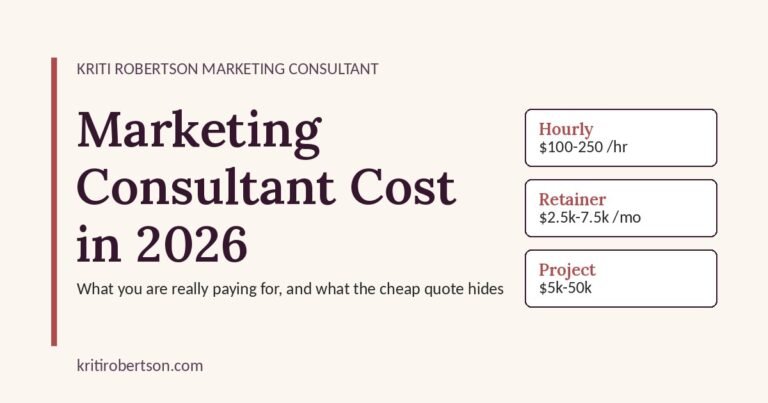
If you only read one section, read this one. In 2026, an experienced independent business marketing consultant in the US, UK or Asia Pacific typically charges somewhere between $100 and $250 an hour, with senior strategists and fractional marketing leads going well above that. Monthly retainers for strategy plus one or two channels usually land between $2,500 and $7,500 a month. Fixed-fee projects run from a few thousand dollars for an audit to five figures for a full strategy with a 12-month roadmap.
Those are the ranges. Here is the caveat that matters more than the ranges. Two consultants quoting the same $5,000 a month can be selling completely different things. One is selling hours. The other is selling a result. The marketing consultant cost that looks identical on the invoice is not identical in what it buys you, and the rest of this post is about telling the difference.
The five ways consultants charge, and what the data says
Consulting Success surveyed close to 1,000 consultants for its 2026 fees study. The split on pricing models was this: 30 percent charge project-based fees, 29 percent bill by the hour, 16 percent work on a monthly retainer, 15 percent price on value, and 10 percent charge a day rate. You can read the full study on the Consulting Success consulting fees page.
Two findings in that study are worth more than the ranges above. First, consultants who price on value or by project are far more likely to land engagements of $10,000 or more than those who bill hourly, 51 percent against 39 percent. Second, 44 percent of consultants now offer a productised service, up from 30 percent in the previous study. The market is moving away from selling time and towards selling defined outcomes and packaged work.
I read that as good news for owners, not just for consultants. When a consultant is willing to put a fixed number on a defined outcome, they are carrying the risk of their own estimate. When they bill by the hour, you are carrying it.
Why the hourly number tells you the least
I wrote a separate piece on marketing consultant hourly rate, so I will keep this short. An hourly rate is a measure of input. It says nothing about how many hours a job should take, and it quietly rewards slowness. A $150 an hour consultant who takes 40 hours to set up conversion tracking has cost you $6,000. A $300 an hour consultant who has done it 50 times and finishes in 8 hours has cost you $2,400. The cheaper rate was the more expensive option.
The hourly number also hides who is doing the work. When a small business marketing consultant quotes you an hourly rate, ask who the hour belongs to. If the answer is “my team”, you are usually paying a senior rate for junior hands. That is the agency model wearing a consultant’s badge.
What an agency retainer hides inside the price
Almost every business owner who comes to me has already spent thousands with agencies or freelancers. The pattern is so consistent I could write it before the call. They were sold a retainer, the account was handed to a junior account manager within the first month, each channel sat in its own silo, and the monthly report was a PDF full of impressions and clicks that never connected to revenue. By the time they reach me they are burnt out and find it hard to trust anyone, even when what I am saying makes sense to them.
My own positioning did not come from a branding exercise. It came from a client I still work with today. Before me, they hired a big agency with lots of reviews and high-profile logos in its case studies, and got a very substandard service. Watching what that did to them was the moment I decided Kriti Robertson Marketing Consultant would not be an agency. KRMC would be a consultant who delivers what agencies cannot: ownership, transparency, and senior strategic thinking with the implementation attached.
So when you compare an agency retainer to a consultant’s fee, do not compare the monthly numbers. Compare what is inside them. An agency fee has to cover the account manager, the project manager who manages the account manager, the office, the new business team, and the margin. The part of the fee that actually reaches your marketing is often a fraction of the invoice. A consultant’s fee has no overhead layer. Clients do not pay for overhead because there is not any.
The three things you are actually paying for
Strip away the pricing model and there are only three things worth paying a consultant for. Everything else is packaging.
The first is diagnosis. A good marketing strategy consultant does not start with a channel. I start by finding the biggest constraint to growth, then use marketing as part of the solution. One client came to me for marketing help, and once I looked closer the real problem was operations: broken links through the customer journey, too many manual processes, systems that did not talk to each other. I could have ignored it and run campaigns. Instead I flagged the operational bottlenecks for them to fix in parallel while I built the marketing system from the ground up. Marketing accelerates growth, but it also accelerates problems. If operations are broken, great marketing just helps more people experience those problems.
The second is judgement with the reasoning attached. When I started KRMC I sold a clarity session: I would help clients clarify their marketing, give guidance on strategy, and they would do the implementation themselves. A few conversations changed my mind. Business owners are too busy running their businesses to think about their own marketing, let alone execute it. They did not want guidance. They wanted someone they could trust and hand the whole thing to. So I rebuilt the consultancy around done-for-you strategy plus implementation. The lesson for your budget is simple: paying for advice you will never have time to act on is the most expensive kind of cheap.
The third is ownership. At an agency, the person who wrote the strategy is rarely the person checking your conversion tracking three months later. With an independent consultant, it is the same person. Nothing gets lost in handoffs because there are no handoffs. That is not a soft benefit. It is the reason the work compounds instead of resetting every time a new account manager is assigned.
What cheap actually costs you
Here is a cost that never shows up on a quote. Before I spend a dollar on ads for an ecommerce client, I make a test purchase on their website with my own card, end to end, to verify every tracking event fires: add to cart, checkout initiated, purchase. On one account I found bugs on the first run, handed the whole test to the developer, and re-ran it until every event passed. Those events are what teach the ad platforms who your buyers are. If tracking is broken, the algorithm learns from rubbish and you pay full price for it.
A cheaper consultant, or a junior at an agency, skips that step because it is boring and nobody sees it. Then the account spends for six months optimising towards page views. I audited a Meta Ads account exactly like this. Consistent spend, decent engagement, retargeting audiences already built, and every campaign objective set to reach, profile visits or link clicks. Meta had no idea what a valuable customer looked like for that business. Busy is not the same as working.
That is what the low quote buys you. Not a discount. A delay, plus the ad spend wasted during the delay, plus the cost of hiring someone competent afterwards to undo it. When you weigh up marketing consultant cost, put a number on that risk. It is usually larger than the gap between the two quotes.
How I price, and why
I am not going to pretend my pricing is the only sensible way to do it, but I will show you the logic so you can test it against whoever you are talking to.
The Full-Stack Strategic Retainer covers strategy, Meta ads, SEO and AI automation under one roof, and it is capped at three clients. The cap is not scarcity marketing. Two people can do a lot, but not everything for everyone, and the moment I take a fourth retainer the quality of the first three drops. The retainer runs on zero lock-in contracts. Retention should be earned every month through results and communication, not enforced through legal terms. Agencies lock clients in for 6 or 12 months precisely because they know month three is when the doubts start. If the only thing keeping a client is a signature, the relationship is already over and both sides are waiting it out.
The Local SEO Sprint exists because of one meeting. I was ready to propose a full marketing strategy, and once I actually spoke to the client I realised they were a small business owner who needed urgent fixes, not market research. They did not even have a website. So I put strategy aside for straight implementation, because sometimes you do what the budget allows. That is why the Sprint is a fixed fee, 14 days, focused on the Google Business Profile, with 4 slots a month. If you are a local operator weighing up a local seo consultant, a fixed-fee sprint is a much safer first purchase than an open-ended retainer.
The Template Shop is the lowest rung on the ladder. It is the same SOPs, frameworks, prompt libraries and tracking dashboards I use inside client work, productised for owners who are not ready for a retainer. Most consultants guard their internal processes like trade secrets. I sell mine, because the process was never the moat. The thinking behind it is.
Three offers, three price points, and each one is a defined outcome rather than a block of hours. That is deliberate. It is also, according to the Consulting Success data above, where the whole market is heading.
How to budget for a marketing consultant
A few practical rules I give to founders who ask me what they should set aside.
Budget for the fix before the growth. Clients almost always want to talk about scaling first: more ad spend, more content, more channels. On a recent ecommerce project I structured the roadmap in three deliberate phases instead. Fix in months one and two, covering tracking, catalogue and basic conversion mechanics. Focus in months two to four, owning the one search intent the data already proved was converting. Only then Grow. Scaling a broken funnel just gets you a bigger broken funnel, faster. Your first three months of consultant spend should be weighted towards the fix, and you should be suspicious of anyone who proposes scaling before they have seen your tracking.
Separate the fee from the media. A consultant’s fee and your ad spend are two different lines. The same applies to SEO: an organic seo consultant fee buys strategy, content and technical work, and the results take months to compound, so budget for at least two quarters before you judge it. If a digital marketing strategy consultant quotes you $4,000 a month, ask whether that includes any media. If it does not, and it usually should not, the total cost of the channel is fee plus spend, and both need to beat your breakeven cost per acquisition. I set a hard rule on every account: pause any ad spend that cannot beat a calculated breakeven, no exceptions, no “let’s give it one more week”.
Price the alternative honestly. Compare the consultant’s fee not to zero but to what you would otherwise do. A part-time marketing hire, an agency retainer, or your own evenings. I have written about how much it costs to outsource marketing in more detail, and the honest comparison is rarely the one that looks cheapest on paper.
Budget for systems, not just campaigns. Some of the highest-return work I do is not a campaign at all. It is a marketing automation specialist job: wiring the email list, the CRM and the tracking together so every future campaign compounds. It is unglamorous and it is the part most agencies never touch, because it does not produce a pretty slide.
Questions to ask before you sign
These are the questions I would want a prospective client to ask me, because the answers separate consultants from agencies in disguise.
Who exactly does the work, and will I ever be handed to someone else. What is the first thing you will look at, and why. If the answer is a channel rather than my numbers, that is a tell. What does the fee include, and what is the media budget on top. What happens if I want to leave after two months. How will you report, and will the report connect to revenue or to impressions. Can I see a case study with the actual numbers, not just the logo.
One more, and it is the one I ask clients myself. When a client once told me they wanted to be more aggressive with their marketing, I asked what aggressive meant to them. More spend, faster timeline, or bigger targets. Those are three different plans with three different costs. Half of the frustration around marketing consultant cost comes from a consultant hearing a vague word and confidently building the wrong thing. Make the vague word specific before anyone quotes you.
The verdict
A consultant is not cheaper than an agency because they charge less. Often they do not. They are cheaper because more of the money reaches the work, the work is done by the person who designed it, and you can leave the moment it stops paying for itself. If you take one thing from this post, take that. The right question is not “what does a marketing consultant cost”. It is “what does this consultant’s fee buy me that I could not get anywhere else, and how quickly will I know”.
If you are an established founder tired of fragmented retainers, or a local operator who wants a fixed-fee starting point, the three offers above are how I answer that question. If you would rather work it out yourself first, the Shop is where I keep the frameworks I use to do it. Either way, get the tracking fixed before you spend a dollar on growth. That one is free.