How to Beat a Large Company at SEO When You Are the Smaller Business
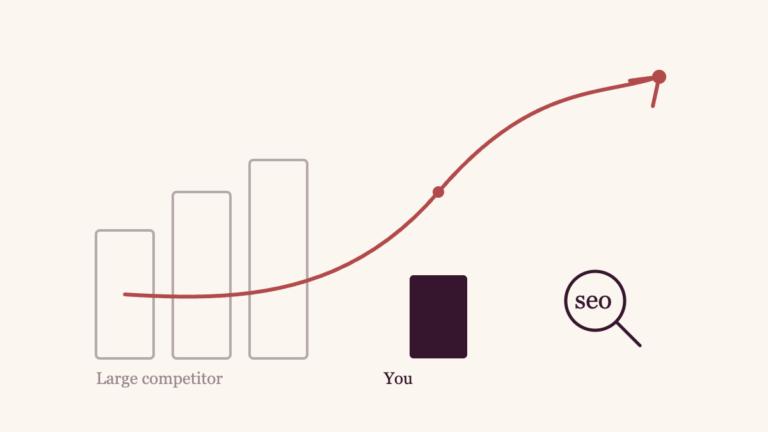
Every few weeks a founder tells me the same thing: “We can’t rank because [big competitor] owns Google.” They have watched a company with a hundred times their budget sit at the top of every search result, and they have quietly decided the game is rigged. So the real question is not whether you can win. It is how to beat a large company at SEO when they have more money, more pages, and a ten-year head start. I have done this for clients who were genuinely outgunned, and the answer is never to fight the giant on the ground they already own. It is to stop playing their game and start playing yours.
Large companies win the broad, high-volume terms because domain authority compounds. They have thousands of backlinks, a content team, and years of accumulated trust signals. If you go head-to-head for “running shoes” or “accounting software,” you will lose, and you will spend a year losing. That is not pessimism. It is arithmetic. But the arithmetic cuts both ways, and once you understand where it breaks in your favour, beating a large company at SEO stops being a fantasy and becomes a plan.
The statistic that exposes the giant’s blind spot
Here is the number that should change how you think. In an analysis of 306 million keywords, Backlinko found that 91.8% of all search queries are long-tail — specific, multi-word phrases that each get searched only a handful of times a month. Google reconfirmed this pattern held in 2025, even as AI-driven, conversational searches became more common. Roughly 92% of all keywords get ten or fewer searches per month.
Read that again, because it is the whole strategy. The giant is built to capture the loud 8% — the fat head terms with huge volume. Those terms justify their content budget and their PR team. But no large company can profitably write a genuinely useful page for a query that eleven people search each month. Their economics do not allow it. Their approval processes do not allow it. Their brand guidelines do not allow it. That long tail is a field the size of the entire internet, and most of it is standing empty because the big players cannot be bothered to walk into it. That is your ground.
Find the whitespace nobody is defending
I look for the gap before I look at what is winning. Researching competitors for one ecommerce brand, I found a category with a single dominant player who owned the “lifestyle” positioning and outspent everyone, surrounded by a pack of smaller brands all copying that same lifestyle angle. Nobody was competing on proof, certification, or credibility. Nobody was even active on YouTube or Pinterest. The opportunity was never to out-spend the giant on their own turf. It was to walk, uncontested, into the two or three spaces every competitor had left empty.
SEO works exactly the same way. Do not audit the big company to copy them. Audit them to find what they are structurally incapable of doing. They probably have a thin, generic page for your entire category. You can write twenty specific pages — one for each use case, each city, each objection, each “how do I” question a real buyer types at 11pm. They answer the question “what is X.” You answer “what is X for a two-person clinic in Leeds with no in-house marketer.” Same topic. Opposite depth. The giant cannot follow you there without breaking their own model, and that is precisely why you win.
Own the ground where proximity beats authority
If you serve a place, local search is the most winnable fight you have, because Google weighs relevance and proximity, not just raw domain strength. A national brand cannot be more local than you in your own town. This is where I see the most money left on the table. I scored one client’s Google Business Profile and their reviews came back 4 out of 5 — genuinely excellent, high volume, strong ratings. Then I scored the rest of the profile: wrong category, no posts, no products, photos two to six years old, zero keyword alignment. Total score: 26 out of 60.
That is the pattern everywhere. Owners assume reviews are the whole game, so they go complacent the moment reviews look good. But reviews build trust once someone is already looking at you. They do nothing to help someone find you in the first place. A large competitor with a distant head office and a neglected local listing is beatable by any small business that treats its Google Business Profile as a live asset. This matters twice over now, because AI search tools lean heavily on those profiles when they recommend a business — a profile with the wrong category and years-old photos is invisible in Maps and invisible in every AI answer built on top of it. Getting this right is the entire premise of the fixed-fee work I run as a local seo consultant, and it is usually the fastest ranking win a smaller business can buy.
Answer the questions the giant is too big to answer
Search behaviour has shifted from keywords to questions. People type and speak full sentences now, and they expect a direct answer. A large company answers in the flattened, legally-reviewed, committee-approved voice that survives ten rounds of internal sign-off. It is accurate and it is forgettable. You do not have that constraint. You can write the way you actually talk to a customer, name the awkward objection out loud, and put a real opinion on the page.
I saw this with a tailoring client whose competitors were 40-year-old firms. The instinct was to hide how young the brand was. Instead we flipped it: the story became that we had other career paths available but chose to carry forward our mother’s legacy because we saw the craft behind it. Same fact, opposite conclusion. Most brand weaknesses are not lies you need to hide — they are unfinished stories. In SEO terms, your “weakness” of being small is what lets you publish content with a point of view. The giant’s content has to please everyone, so it commits to nothing, so it ranks for nothing specific. Yours can be sharp enough to be the best answer to a real question, and being the best answer is the only ranking factor that has never gone out of date.
Move fast, because that is the one resource you have more of
A large company takes six weeks to approve a blog post. By the time their content clears legal, brand, and three stakeholders, you can have published, measured, and improved five pages. Speed is a ranking advantage that nobody puts in the ranking-factor lists, but it is real: more pages tested, more queries covered, faster iteration on what is actually working. This is why I keep my own consultancy at a headcount of two. Nothing gets lost in handoffs because there are no handoffs. The person who writes the strategy is the person checking the results. You have the same structural edge over any big competitor — use it before you scale it away.
Pair that speed with genuine focus. I structure SEO roadmaps in phases: fix the technical and tracking basics first, then focus relentlessly on the one search intent the data already proves converts, and only then grow into adjacent topics. Clients almost always want to start at grow — more content, more keywords, more channels. Scaling an unfocused SEO effort just gets you a bigger unfocused effort, faster. Pick the cluster of long-tail queries where you can plausibly be the best answer in your niche, own it completely, then move to the next one. This is the backbone of how I work as a marketing strategy consultant: sequence beats volume every time.
Measure the right thing, or you will quit too early
The reason most small businesses give up on SEO against a big competitor is that they measure the wrong number. They watch rankings for the head term the giant owns, see themselves stuck on page four, and conclude it is hopeless. Meanwhile the twelve long-tail pages they published are quietly bringing in qualified buyers who convert at three times the rate, because someone searching a specific ten-word question is far closer to a decision than someone searching a broad two-word term. Track pipeline and conversions, not vanity positions on keywords that were never yours to win. I would rather see a client ranking first for forty specific phrases that each print revenue than languishing on page two for one glamorous term that mostly attracts researchers and competitors.
The honest summary
So, how do you beat a large company at SEO? You do not beat them. You go around them. You concede the loud 8% they were always going to own, and you take the 91.8% they were never built to serve. You find the whitespace their competitors are too busy copying each other to notice. You out-local them where proximity outranks authority. You answer the specific questions they are too big and too cautious to touch. And you move faster than any organisation running on approval chains ever can.
This is not a trick, and it is not a shortcut. It is a different game played on purpose. If you want a second set of eyes on where your winnable ground actually is, that is the work I do every day as an organic seo consultant — the practical, done-with-you version of everything above sits inside my small business seo services, and it always starts the same way it did here: with the numbers, not a hunch. Being small was never the disadvantage you were told it was. Used correctly, it is the whole reason you can win.