How to Build an Automation Strategy Before You Automate Anything
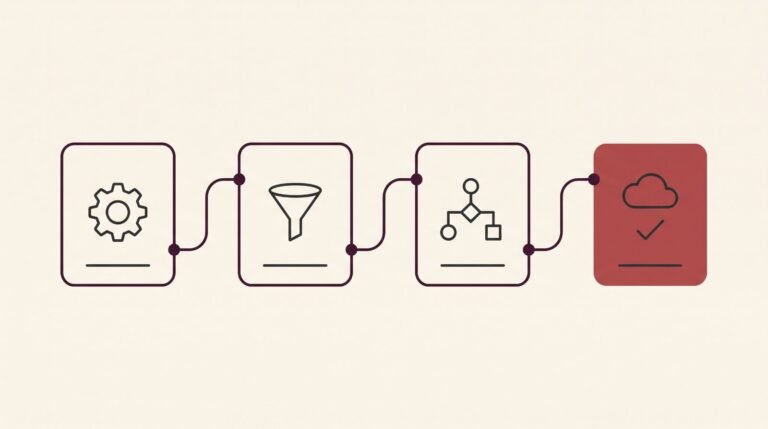
Most people ask me how to build an automation strategy and what they really mean is “which tool should I buy.” That is the wrong first question. I have watched businesses wire up Zapier, buy a fancy CRM, connect five apps together over a weekend, and six months later they are paying for software that has quietly made their mess run faster. The tool was never the problem. The order they went about it was.
So before I talk about triggers and workflows, I want to walk through how to build an automation strategy the way I actually do it with clients, which starts a long way before anything gets automated.
Automation is not new, but most of it is still guesswork
The adoption numbers are worth sitting with. Around 66% of organisations have now adopted automation in at least one business function, up from 57% the year before, according to Quixy’s 2026 workflow automation research. That sounds like everyone is ahead of you. Then you read the next line: only 4% have reached genuinely hands-free, fully automated operations, and just 31% have fully automated even one key function (Quixy, Workflow Automation Statistics 2026).
Read those two figures together and the picture is honest. Almost everyone is automating something. Almost nobody has a strategy behind it. They have bought tools and bolted them onto whatever was already there. The gap between “we use automation” and “our automation actually works” is the whole game, and that gap is a strategy gap, not a software one.
Find the biggest constraint before you find a tool
I once took on a client who came to me wanting marketing help. More leads, better campaigns, the usual brief. Once I looked closer, their real problem was not marketing at all. It was operations. Broken links right through the customer journey, too many manual processes, systems that did not talk to each other. Someone was copying data from one place to another by hand every single day.
I could have ignored all of that and just run campaigns. Instead I was upfront with them: marketing alone would not solve this. I flagged the operational bottlenecks for them to fix while I built their marketing system, so we were not just generating more demand, we were preparing the business to actually handle it.
Here is the principle I keep coming back to, and it applies directly to automation. Marketing can accelerate growth, but it also accelerates problems. Automation does exactly the same thing. If your underlying process is broken, automating it does not fix it. It just lets the broken thing happen faster and at a larger scale, and now you are paying a monthly subscription for the privilege. Great automation on top of a bad process just helps more people experience the bad process.
So the first step in how to build an automation strategy is not a step you would expect. It is diagnosis. I do not start with the tools. I start by finding the single biggest constraint to growth, and only then do I ask whether automation is part of the solution or whether the honest answer is that the process needs redesigning by a human first. This is the same instinct a good business marketing consultant brings to any brief: find the real bottleneck before spending a dollar against the wrong one.
Step one: map the process by hand before you automate it
Write out the workflow you are thinking of automating, exactly as it happens today, step by step, with the person who owns each step. Not how you wish it worked. How it actually works, including the awkward bits where someone has to remember to do a thing, or chase someone else, or check a spreadsheet.
Two things happen when you do this. First, you almost always find steps that should not exist at all. Do not automate those. Delete them. Automating a step you could have removed is one of the most common and expensive mistakes I see. Second, you find the steps that are genuinely repetitive, rule-based and high-volume. Those are your real automation candidates. Everything else can wait.
This is the same discipline I use before spending a single dollar on ads: I build a clean baseline first, because if you build a twelve-month plan on top of dirty numbers, every decision after that is wrong by the same margin. Automation is identical. Map the truth first, or you will automate the fiction.
Step two: rank candidates by boring, not by exciting
Once you have your list of genuine candidates, resist the urge to start with the clever, impressive automation. Start with the boring one that runs every day and eats time. The task nobody enjoys, that happens on a predictable trigger, with a predictable outcome. That is where automation pays you back fastest.
The returns here are real when you pick correctly. Forrester documented a 248% three-year return on enterprise automation deployment, and over half of businesses see full payback within twelve months (Quixy, 2026). But those numbers come from automating the right things. A high-volume, rules-based task returning hours every week beats a beautiful workflow you set up once and use twice. I would rather see one clean automation quietly saving three hours a week than ten half-finished ones nobody trusts.
Step three: decide what stays human on purpose
A good automation strategy is as much about what you refuse to automate as what you automate. I have rules about this, and they come from watching automation go wrong.
My rule for content is the clearest example. There is technically nothing wrong with AI-written content. Google itself says it rewards helpful, people-first content regardless of who wrote it. But I never let it publish automatically. A human goes through every piece and adds real examples and stories before it goes live. On one account, an AI blog tool was writing beautifully optimised articles for keywords that twenty people a month search for. Ninety percent keyword score, near zero demand. Automation was doing its job perfectly and producing nothing of value, because nobody had decided what it should be pointed at.
That is the lesson for any automation, not just content. Use it for speed, never for the judgement. The moment where a person decides what matters, checks the numbers, catches the thing that reads wrong, that stays human on purpose. Automate the doing. Keep the deciding.
Step four: sequence it like Fix, Focus, Grow
Clients almost always want to talk about the exciting end first. More tools, more connected apps, a fully automated business by Christmas. On a recent project I structured the roadmap in three deliberate phases instead, and the same shape works for automation.
Fix comes first. In the early weeks you clean and connect the plumbing: the tracking, the data, the one or two processes that are actively leaking time or money. Focus comes next. You automate the single workflow the diagnosis proved was your biggest constraint, and you get it working reliably before you touch anything else. Only then comes Grow, where you extend automation across more of the business, now that you have proof it holds.
Scaling a broken funnel just gets you a bigger broken funnel, faster. Scaling broken automation is the same thing with a monthly invoice attached. Sequence matters more than speed.
Step five: build in a check, because things always go wrong
Every automation needs a person who would notice if it silently stopped. I have spent four days on the phone to Meta support because an account got locked for no reason anyone could explain, so I have a healthy respect for systems that fail quietly. An automation that breaks loudly is annoying. An automation that breaks quietly, and keeps reporting success while doing nothing, is dangerous, because you build on top of it assuming it works.
So the last step in how to build an automation strategy is the least glamorous. Decide who checks it, how often, and what “working” actually looks like in numbers. Deadlines placed early enough are what remove pressure, not add it, and the same is true of checks. A five-minute weekly review of your key automations is the cheapest insurance you will ever buy.
Where a consultant fits, and where you do not need one
You can do a lot of this yourself. Mapping your own processes, deleting dead steps, automating one obvious repetitive task, none of that needs outside help, and I would rather you started than waited. Plenty of small business owners get real value from tackling the first two or three workflows on their own.
Where it gets harder is when automation, marketing and operations are tangled together and you cannot tell which one is actually holding you back. That is the diagnosis problem. When the work is genuinely a systems problem, an email marketing consultant or a dedicated marketing automation specialist can build and connect the workflows properly, so you are not the one debugging a five-app chain at eleven at night. And for a smaller local operator who just needs a couple of manual processes taken off their plate, a small business automation consultant can often sort it in days rather than months.
The honest version is this. Sometimes you need a strategist to tell you what to automate and in what order. Sometimes you just need to start, because the biggest time-saver in your business is a task you already know you hate doing by hand. Either way, the sequence is the same. Diagnose, map, rank, decide what stays human, sequence it, and check it.
Automation is not a tool you buy. It is a decision about what your business should never have to do by hand again. Make that decision well, in that order, and the tools become almost boring. Which is exactly how you want them.