Kriti Robertson is an independent business marketing consultant based in Hong Kong. She works with a small, capped roster of business owners who are tired of agencies that sell tactics before they have a strategy. Her work covers marketing strategy, organic SEO and a 14 day Local SEO Sprint for businesses that need customers now.
Fractional CMO for Startups: When It Makes Sense, When It Doesn't, and What to Ask First
Most founders who ask me about a fractional CMO for startups are not asking because they want another senior person on the payroll. They are asking because they have already tried the alternatives. A freelancer here, an agency there, a growth hire who lasted eight months. Money went out, dashboards looked busy, and nobody in the building could explain in one sentence why the marketing was or was not working. That is usually the moment the words “fractional CMO” come up.
I am Kriti Robertson, and I run Kriti Robertson Marketing Consultant, or KRMC for short. I work as a fractional CMO for startups, and as a strategic marketing consultant for established founders, under a retainer I cap at three clients, so I see this decision from the inside. This post is the plain version of what I tell people who ask: what the role actually is, when it makes sense for a startup, when it does not, what it should cost relative to the alternatives, and the questions I would ask any fractional CMO before signing.
What a fractional CMO for startups actually does
A fractional CMO is a senior marketing leader who works for your business part of the week rather than all of it. The title is borrowed from big companies, but the job at a startup is much more hands-on than the corporate version. At a Fortune 500 firm the CMO manages a department. At a startup with six people, the fractional CMO is the department, at least until the strategy has proved itself and there is a reason to hire underneath it.
In practice the work splits into three parts. First, diagnosis: a proper marketing audit of what you have, what is tracking, and where the money is leaking. Second, direction: one document that defines who you are for, what you stand for that competitors do not, which channels earn a place in the plan, and a 12-month roadmap with numbers attached. Third, ownership of execution. Not “oversight”, ownership. If the ads are not converting, the fractional CMO is the person who opens the ad account and finds out why, not the person who forwards the question to an account manager.
That third part is where most fractional arrangements quietly fail, so I will come back to it.
Why startups end up here
The pattern I see most often is a business that has done a lot of marketing and very little marketing thinking. They launched a website, started posting, hired a Meta ads agency, then an SEO agency, then spent a few thousand dollars a month on Google Ads. Six months later they ask why none of it is working. When I ask what success looks like, or who exactly they are trying to reach, there is often a pause. Nobody had defined it. Every activity was a guess dressed up as a plan.
Strategy comes before execution, not because strategy is exciting but because without it every dollar spent is a bet with no odds attached. My version of strategy is not a 100-page deck. It is a North Star: one place that holds your target audience, positioning, messaging, brand voice, USPs, competitor gaps and the 12-month roadmap. That document becomes the filter for every spending decision after it. A fractional CMO for startups exists to write that document, and then to hold everyone, including the founder, to it.
If you are still unsure whether your problem is strategic or tactical, I wrote about the difference between business strategy and marketing strategy, and the short test in there applies here too.
The research nobody quotes to founders
The interesting number in this space is not about startups at all. It is about the biggest companies in the world, and it explains why the fractional model has spread downward.
Spencer Stuart, the executive search firm, has tracked CMO tenure for more than 20 years. Its CMO Tenure Study 2025 found that the average CMO tenure at Fortune 500 companies was 4.3 years, below the C-suite average of 4.9, and that 34 percent of Fortune 500 companies had no enterprise-wide CMO at all. A third of the largest firms on earth have decided, for now, that they can run marketing without a single full-time chief.
Read that alongside your own situation. If Fortune 500 boards struggle to make a full-time CMO stick for much more than four years, a two-year-old startup with an unproven channel mix and a runway measured in months should not feel obliged to make a $250,000-a-year hire before it knows what the role even needs to be. The fractional CMO for startups is the honest answer to that mismatch: senior direction now, at a fraction of the fixed cost, with the full-time hire deferred until the strategy has earned it.
When it makes sense
I would tell a founder a fractional CMO is the right move in four situations.
You have product-market fit, or something close to it, and revenue is being held back by marketing rather than by the product. If the product is not ready, no amount of marketing leadership fixes that, and a good fractional CMO will tell you so in week one.
You are spending money on channels and cannot say which of them is profitable. Busy is not the same as working. I audited a Meta ads account last year that looked healthy on the surface: consistent spend, decent engagement, retargeting audiences already built. Every campaign objective was reach or link clicks, and the pixel tracked page views only. Meta had no idea what a paying customer looked like for that business, so it was optimising for attention, not revenue. That account did not need more budget. It needed someone senior to notice.
You have hired, or are about to hire, agencies and freelancers with nobody senior to brief and check them. Vendors without a strategist above them will each optimise for their own channel and their own report. A marketing strategy consultant in the fractional seat gives them one brief, one set of targets and one person who reads the numbers every week.
You need to prove marketing works before your next raise, and you need it in months rather than years. That is growth strategy consulting with a deadline attached, and it is the situation the fractional model was built for.
When it does not
It does not make sense when the founder wants a full-time presence, daily stand-ups and someone at every meeting. Fractional means fractional. If the honest need is 40 hours a week, hire for 40 hours a week.
It does not make sense when the business cannot yet support any marketing spend beyond the retainer. A fractional CMO with no budget to direct is an expensive advisor. A rough guide I use: if the retainer would be more than half of your total monthly marketing spend, you are probably too early, and a fixed-scope engagement is the better fit.
And it does not make sense when the founder is not willing to be told no. The disagreements are the value. I once had a client who wanted more followers, wanted to focus on TikTok, and wanted to avoid B2B entirely. I disagreed with all three and said plainly: it is your business, but if you are paying me as a consultant, this is my recommendation. They followed every one and the results proved it out. If you want someone to execute your existing instincts, a freelance marketing consultant on an hourly rate is the cheaper way to get that.
What it should cost, and what it should replace
Costs vary a great deal by market and seniority, so I will not pretend there is one number. What I will say is how to think about it. A full-time CMO in most markets is a six-figure salary plus equity plus the hires they will immediately want to make. A fractional engagement typically runs at a fixed monthly retainer, and the honest comparison is not fractional versus full-time. It is fractional versus the stack of vendors you are already paying.
Add up the Meta ads agency, the SEO agency, the freelance copywriter and the tool subscriptions nobody has reviewed. In most startups I audit, that total already exceeds what a senior fractional retainer would cost, and none of those parties owns the outcome. If you want the fuller breakdown, I covered the maths in how much it costs to outsource marketing.
The other cost is time. Pouring money into a leaky bucket for another six months is more expensive than any retainer, because you do not get the six months back before the next raise.
The roadmap I would expect in the first 90 days
This is the part I would hold any fractional CMO to, including myself. If you cannot see a version of it in their proposal, keep looking.
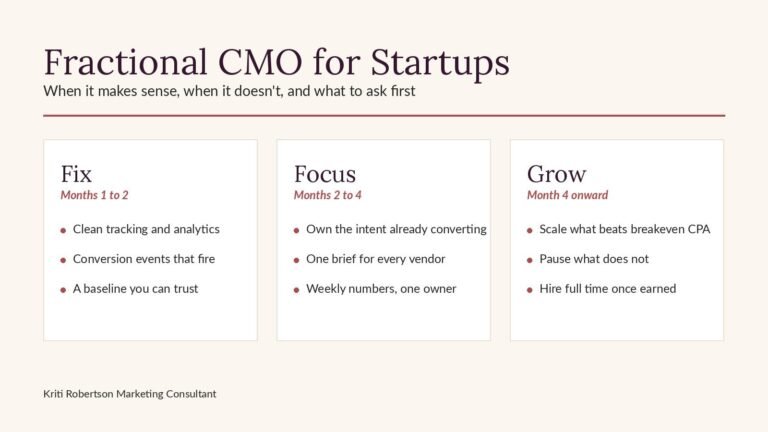
Months one and two are Fix. Tracking first: conversion events, clean analytics, a baseline you can trust. On one ecommerce account the reported traffic included a chunk of visitors from countries with no business reason to be there, almost certainly internal team traffic, and the ad accounts were billing in a different currency to the reporting currency. Build a 12-month plan on numbers like that and every decision after it is wrong by the same margin. Cleaning the data is not the boring part before the real work starts. It is the real work.
Months two to four are Focus. The data will usually show one search intent, one audience or one offer that is already converting. Own that before adding anything. This is where I would bring in the specialist work, whether that is an organic SEO consultant building out the pages that intent deserves, or a marketing automation specialist making sure every lead that comes in is followed up without a human remembering to do it.
Only then is it Grow. And even then, with one hard rule attached: pause any ad spend that cannot beat a calculated breakeven cost per acquisition. No exceptions, no “let us give it one more week.” Scaling a broken funnel just gets you a bigger broken funnel, faster.
Questions to ask before you sign
Who actually does the work? At a lot of fractional firms the senior person sells the engagement and a junior team delivers it. That is the agency model with a better job title. Ask who opens the ad account, who writes the strategy, who reads the weekly numbers, and whether you will ever speak to anyone else.
How many clients do they carry at once? Senior attention does not scale. I cap my retainer at three clients for exactly this reason, and I would be cautious of anyone carrying eight.
What will you receive in writing, and how often? Most client relationships do not break over bad work. They break over silence. A written recap on the same day each week, covering what shipped, what is moving and what is blocked, costs 20 minutes and replaces every anxious check-in message you would otherwise send.
What is the exit? I run on zero lock-in contracts because retention should be earned every month through results, not enforced through legal terms. If a fractional CMO wants a 12-month commitment from a startup, ask why they need it.
Do they do strategy only, or strategy plus implementation? When I started KRMC I offered a clarity session: I would set the direction and the founder would execute. The conversations that followed changed my mind. Founders are too busy running their businesses to think about their own marketing, let alone build it. They did not want guidance. They wanted someone they could trust and hand the whole thing to. That is why the retainer became strategy plus hands-on delivery across paid, SEO and automation, and why I would look for the same from anyone else you consider.
Where this fits at KRMC
My Full-Stack Strategic Retainer is the fractional CMO for startups in everything but the title. Meta ads, SEO and AI automation under one senior owner, with a maximum of three clients at any time. If you are a local operator who needs fast fixes rather than a 12-month plan, the local SEO consultant work I do through the 14-day Sprint is the better starting point, and it costs a fraction of a retainer. Either way, the process starts the same way: I audit what you have and tell you exactly where the leaks are before anyone talks about spending more.
If you want to talk it through, the simplest place to start is the business marketing consultant overview on the homepage, or the small business consultant services page if you would rather see the full menu first.