Kriti Robertson is an independent business marketing consultant based in Hong Kong. She works with a small, capped roster of business owners who are tired of agencies that sell tactics before they have a strategy. Her work covers marketing strategy, organic SEO and a 14 day Local SEO Sprint for businesses that need customers now.
Marketing Consultant Hourly Rate in 2026: What the Numbers Say and What They Hide
Every few weeks someone emails me with the same opening line: what is your marketing consultant hourly rate? It is a fair question. It is also the wrong first question, and I will explain why before I give you the numbers, because the numbers on their own will send you towards the cheapest option, and the cheapest option is how most of my clients ended up burnt out before they ever met me.
I am Kriti Robertson, and I run Kriti Robertson Marketing Consultant, or KRMC for short. I work with established founders who have already paid an agency or two, and with local operators who need something fixed this month, not a 40-page deck. Both groups ask about the marketing consultant hourly rate. Both usually leave the first conversation caring about something else entirely.
So here is what the rate actually is in 2026, what sits inside it, and when paying by the hour is the right call versus the expensive one.
What a marketing consultant hourly rate looks like in 2026
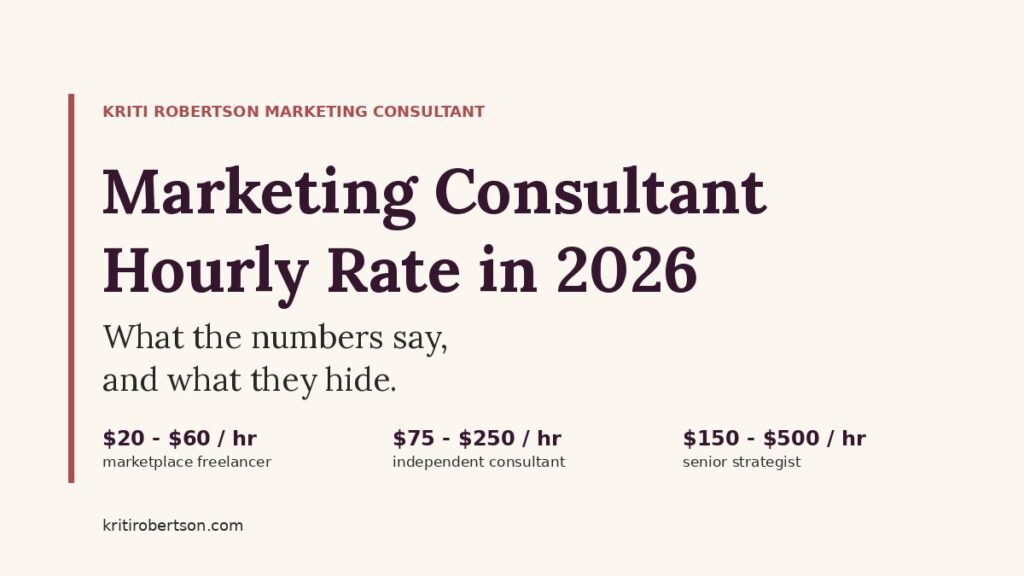
The most recent planning ranges I trust come from OuterBox’s marketing consultant cost guide, updated in September 2026. Their synthesis puts an independent marketing consultant at $75 to $250 per hour, and a senior specialist or fractional marketing leader at $150 to $500 per hour when the work is strategic, technical, or tied to revenue. Global freelance marketplaces sit far below that, at roughly $20 to $60 per hour according to Upwork’s own data. And for context on the alternative, the US Bureau of Labor Statistics reports a median marketing manager wage of $161,030 a year before benefits, tools or recruiting costs.
So the honest answer to “what is the going marketing consultant hourly rate” is: anywhere from $20 to $500, which is no answer at all. A $40-an-hour freelancer and a $250-an-hour marketing strategy consultant are not two prices for the same thing. They are two different jobs that happen to share a job title.
The spread tells you something useful, though. The bottom of the range is paying for hands. The top of the range is paying for judgement, and for someone who carries responsibility for the outcome. Once you see the rate that way, the question changes from “how much per hour” to “which of these do I actually need right now”.
Why the hourly number hides the real cost
I will give you a scenario I see constantly. A founder hires a $60-an-hour freelancer to run Meta ads. Twelve months later they have spent $7,000 on fees and $40,000 on ad spend, and they cannot tell me which campaigns produced a customer, because the pixel only ever tracked page views. The rate looked cheap. The account was busy. Nothing was working, and nobody senior enough was looking at it to notice.
Compare that with a consultant at three times the hourly rate who spends the first week making a test purchase on the website with her own card, finds the tracking is broken, hands the bug list to the developer, and only lets a dollar of ad spend go out once every conversion event fires cleanly. Fewer hours. A much higher rate. A completely different result twelve months on.
That is the problem with comparing rates in isolation. The hourly rate is a cost. What you are trying to buy is a return. A low rate on the wrong work is the most expensive thing in marketing, because you pay the fee and then you pay again in wasted spend, and then you pay a third time in the months you lost.
If you want the full picture on this, I have written separately about how much it costs to outsource marketing across freelancers, agencies and consultants. The short version is that the fee is rarely the biggest line on the invoice.
What is actually inside a senior consultant’s rate
When people see $200 or $300 an hour they assume it is mostly margin. In an agency, a good chunk of it is. You are paying for the account manager who relays your questions to the person doing the work, the project manager who manages the account manager, the office, the new business team, and the case-study video. That is why agency retainers for the same scope can run $5,000 to $50,000 a month and still land your account with someone two years out of university.
At Kriti Robertson Marketing Consultant, the headcount is two, on purpose. I run strategy, paid channels, SEO and everything client-facing. Surbhi runs content, publishing and design coordination. Between the two of us, that is the full stack an agency would spread across eight people plus a layer of managers. Nothing gets lost in handoffs because there are no handoffs. The person who wrote the strategy is the person checking the conversion tracking on a Tuesday morning.
So when you pay a rate at the senior end of the range to an independent consultant, you are not paying for overhead. You are paying for the fact that ten years of pattern recognition compress a problem that would take a junior team three months into something that gets diagnosed in week one. The rate is higher. The number of hours is lower. The cost of getting it wrong is lower still.
It is also why I cap the Full-Stack Strategic Retainer at three clients. Two people can do a lot, but not everything for everyone, and the moment I take on a fourth, the thing you were paying the rate for, senior attention, is the first thing that degrades.
When paying by the hour makes sense
I do not want to pretend hourly is always wrong. It is the right model when the question is narrow and the deliverable is contained. Review this media plan. Pressure-test this SEO roadmap. Sit with my team for two hours and tell us which of these three priorities to pick. In those cases you want a defined block of senior time with no long commitment, and hourly is the honest way to price it.
Hourly also makes sense when you already have a capable in-house team and what you are missing is a second opinion, not a pair of hands. A digital marketing strategy consultant reviewing your channel mix once a quarter is a very different purchase from someone running your channels every day, and it should be priced differently.
The rule I use is simple. If I can tell you at the start roughly how many hours the job will take, hourly is fine. If I cannot, hourly is a risk you are carrying, not me, and I would rather we both know what the work costs before it starts.
When hourly is the expensive option
Hourly falls apart the moment the scope is uncertain, which is most of the time when a business is genuinely stuck. If the brief is “our marketing isn’t working”, nobody knows on day one whether the problem is positioning, tracking, the offer, the website, or the fact that the operations behind the marketing cannot handle the demand it creates. I have had clients where the real constraint turned out to be a broken customer journey, not a broken campaign. On an hourly clock, every one of those discoveries adds cost and every meeting to discuss them adds more. You end up paying for the diagnosis, and then paying again while the consultant has an incentive to keep the meter running.
This is also where I learned something about my own business. When I started KRMC I offered a clarity session: a few hours of my time, some guidance on strategy, and the client would go away and implement it themselves. Priced by the hour, cheap to buy, easy to say yes to. A handful of client conversations changed my mind. The pattern was always the same. Business owners are far too busy running their businesses to think about their own marketing, let alone execute it. They did not want guidance by the hour. They wanted to find someone they could trust and hand the whole thing over. So I stopped selling hours of advice and rebuilt everything around done-for-you strategy plus implementation.
What clients actually buy beats the offer you designed in isolation. Hourly advice was the offer I designed. Ownership of the outcome was what people were trying to pay for.
Three ways to buy a consultant, and what each one is for
Once you stop thinking about the marketing consultant hourly rate as the whole picture, there are really three ways to buy this kind of work, and each fits a different situation.
The first is hourly or a day rate, for contained, well-defined advice. Fine for a second opinion. Wrong for “fix our marketing”.
The second is a fixed-fee project, for a defined deliverable with a defined end. This is how I run the Local SEO Sprint: 14 days, a fixed price, four slots a month, and a Google Business Profile that comes out the other end with the right category, current photos, keyword-aligned services and a review process that actually runs. That offer exists because of one meeting. I turned up ready to propose a full strategy to a small business owner who, it turned out, did not even have a website yet. They needed urgent fixes, not market research. So I put the framework aside and did the implementation, because sometimes you do what the budget allows. Good consultants do not force every client through the same process. You start where the business is, not where your framework begins. A fixed fee makes that possible, because the client knows exactly what they are getting and exactly what it costs before anything starts. A local SEO consultant charging by the hour for that same job would have no reason to finish it in 14 days.
The third is a monthly retainer, for ongoing strategy plus implementation across channels. This is where an organic SEO consultant, a paid media specialist and a marketing automation specialist would normally be three separate invoices. In a full-stack retainer they are one person, and the value is continuity: the consultant learns your numbers, your customers and your constraints, and every month’s decisions get better because of the month before. The risk with retainers is vague activity, a monthly call with no work queue and no measurable next step. The fix is a written operating rhythm. Mine is a Tuesday recap to every client: what shipped last week, what is moving this week, what is blocked and why. Twenty minutes to write. It replaces every “just checking in” message and every anxious silence.
Questions to ask before you compare any rate
If you are collecting quotes from a business marketing consultant or a small business marketing consultant right now, do not compare the hourly figures until you have compared the answers to these.
Who actually does the work? Not who sells it, not who presents the quarterly deck. The person whose hands are in the ad account and the analytics. If the answer is “the team”, ask to meet the team.
What happens in week one? A senior consultant should be able to tell you exactly what they will look at first. My answer is the funnel and the tracking, because if the baseline is dirty, every decision built on it is wrong by the same margin. If the answer is “we’ll kick off with a discovery workshop”, you are paying for a workshop.
What is included and what is not? Strategy only, or strategy plus implementation? Who owns the website changes, the email setup, the landing pages? A cheap rate for advice becomes an expensive rate once you add the freelancer, the developer and the designer needed to act on it.
What ties them to the outcome? I run zero lock-in contracts, and I say so up front, because if the contract is doing the retaining, the work has already failed. Agencies lock clients in for six or twelve months precisely because month three is when the doubts start. Ask what happens if you want to leave in month two. The answer tells you how confident they are in month one.
And finally, what does the last client say? Not the testimonial on the website. The one you can call. I keep my Kriti Robertson Marketing Consultant case studies specific for that reason: numbers, timelines and what actually changed, not adjectives.
What I would do if I were hiring
If the budget is small and the problem is specific, buy a fixed-fee project from someone senior. You will pay more per hour than a marketplace freelancer and less in total than you would paying that freelancer to find their way around your business for six months.
If the budget is meaningful and the problem is “we’ve spent a lot and can’t tell what worked”, stop looking at hourly rates altogether. What you need is one accountable person who owns strategy and implementation across the channels that matter, whether that is a full stack digital marketing consultant, a fractional marketing lead or a small consultancy like mine. Price that on the outcome and the scope, and judge it on pipeline and conversion data, not on clicks and not on how many hours appeared on the invoice.
And if what you have really got is a two-hour question, pay the hourly rate happily, get the answer, and go and act on it. Hourly is a perfectly good way to buy an answer. It is a poor way to buy a result.
The rate is the easy part to compare. What you are paying for is the judgement behind it.