Kriti Robertson is an independent business marketing consultant based in Hong Kong. She works with a small, capped roster of business owners who are tired of agencies that sell tactics before they have a strategy. Her work covers marketing strategy, organic SEO and a 14 day Local SEO Sprint for businesses that need customers now.
Fractional CMO Hourly Rate in 2026: What an Hour Costs and What It Hides
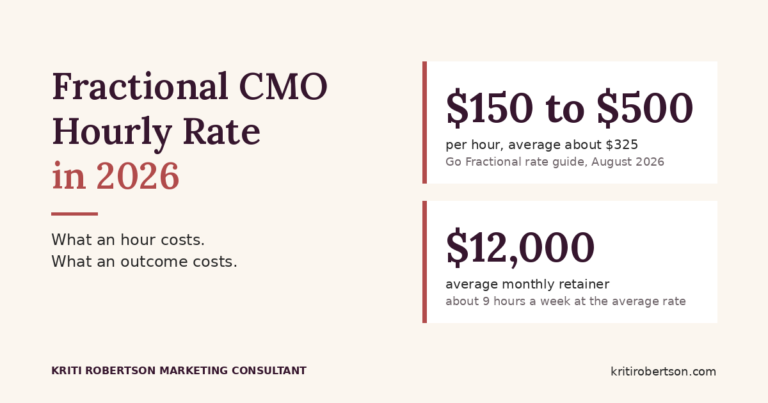
The fractional CMO hourly rate in 2026 runs from $150 to $500 an hour, and the average sits at about $325, according to Go Fractional’s rate guide, updated in August 2026. That is the number people search for, and it is the number I get asked about on almost every discovery call. So I will give it to you first. Then I will explain why, if you hire on that number alone, you will almost certainly pay more than you need to for less than you wanted.
I run Kriti Robertson Marketing Consultant, which clients shorten to KRMC. I sell senior marketing leadership by the month, not by the hour, and I made that decision after watching hourly arrangements go wrong for both sides. This post is the candid version of that argument, including the cases where paying by the hour is the right call.
What the fractional CMO hourly rate actually covers
The spread from $150 to $500 is wide because the title is loose. At the bottom of the range you will find people who ran a marketing team once and now freelance between contracts. At the top you will find operators who have built pipeline at several companies and will not take a call under a certain fee. The Growtal 2026 rate guide narrows the senior band to $200 to $350 an hour, with a typical commitment of 10 to 20 hours a week. Go Fractional’s data has the working range wider, at 5 to 35 hours a week.
Now do the arithmetic most people skip. At the $325 average, 15 hours a week is roughly $21,000 a month. Yet the same Go Fractional data puts the average monthly fractional CMO retainer at about $12,000, inside a $4,000 to $20,000 range. That gap is the whole story. A retainer at $12,000 buys you about 37 hours a month at the average hourly rate, call it nine hours a week. Hourly billing and retainer billing are not two ways of pricing the same thing. They are two different products, and the hourly one is the more expensive of the two per hour of senior attention.
For context, a full-time chief marketing officer’s base salary is around $373,609 in the United States (Salary.com, February 2026), before bonus, equity and benefits. Spencer Stuart’s 2026 tenure study puts the average CMO stay at 4.1 years, still the shortest in the C-suite. So the fractional model exists for a reason. The question is only how to buy it well.
Why I stopped selling my time by the hour
When I started KRMC I offered a clarity session. I would help a business owner sort out their marketing, give them direction on strategy, and they would go and implement it themselves. It was, in effect, an hourly product. A few client conversations changed my mind, and the pattern was always the same. Business owners are too busy running their businesses to think about their own marketing, let alone execute it. They did not want guidance by the hour. They wanted someone they could trust and hand the whole thing to.
So I rebuilt KRMC around done-for-you strategy plus implementation. The lesson generalises. An hourly fractional CMO is paid to advise. A retained one is paid to own an outcome. If what you need is someone accountable for pipeline, not someone available for questions, the fractional CMO hourly rate is the wrong unit of measurement, however low it looks.
Three ways the hourly number hides the real cost
First, the meter rewards the wrong behaviour. Under hourly billing, an unclear brief is profitable. A meeting that could have been an email is profitable. Every rewrite, every additional stakeholder, every “can you just take a look at this” is another line on the invoice. Nobody is acting in bad faith. The incentive simply points at time spent rather than results delivered, and incentives win.
Second, hourly hides the cost of context. A senior marketer needs to hold your numbers, your funnel, your positioning and your history in their head to make good calls quickly. That context is rebuilt every time an hourly engagement pauses for a month and restarts. You pay for the rebuild, and it does not show up as a separate line. It shows up as the first three hours of every re-engagement being spent catching up.
Third, hourly makes you the project manager. I watched this happen on one client account where a web developer was hired to implement my recommendations. Every task went out as a packaged PDF with everything needed to do the job. There was still constant back and forth, questions already answered in the document, and tasks marked done that were not done when I checked. I was spending a large chunk of my time helping the developer do their job instead of doing the job I was hired for. Hourly arrangements drift into exactly that shape. The clock runs while everyone coordinates.
What is inside a senior rate, and what is not
When someone quotes $300 an hour, you are not paying for 60 minutes of typing. You are paying for the years of pattern recognition that let them audit a Meta Ads account in an afternoon and tell you that every campaign objective is set to reach or link clicks, so the platform is optimising for attention rather than revenue. You are paying for the judgement that says fix conversion tracking before you scale spend, not after. A cheaper hour without that judgement is not cheaper. It is slower.
What a senior rate should not include is a layer of people between you and the person you are paying for. This is where the agency model breaks. A monthly fee that looks competitive next to a fractional CMO hourly rate often buys you a junior account manager, a channel silo per specialist and a monthly PDF that reports on impressions. I would rather see a quiet ad account with three clean conversion events than a loud one with none, and I would rather you paid one senior person for nine hours a week than eight junior ones for forty.
When paying by the hour is the right call
I promised the honest version, so here it is. There are three situations where the fractional CMO hourly rate is exactly what you should pay.
The first is a scoped diagnostic. If you want a senior marketer to audit your funnel, your tracking and your positioning and hand you a prioritised list, that is a bounded piece of work. Ten to twenty hours, a fixed deliverable, done. Paying hourly or, better, a fixed fee for that is sensible. My own version is a week one funnel audit that tells you exactly where the leaks are before any retainer conversation starts.
The second is decision support for an in-house team that already executes well. If you have a competent marketing manager and two specialists, and what is missing is someone senior to pressure-test the plan once a fortnight, a few hours a month at a high rate is cheaper than any retainer and far cheaper than a hire.
The third is a short bridge. You are between marketing leaders, or you are three months from being able to afford a proper engagement, and you need someone to keep the wheels on. Hourly, capped, with a clear end date, is fine. Just do not let a bridge become a permanent structure. Bridges are expensive per month for a reason.
When hourly is the expensive option
Everything else. If you need the work done, not just decided, hourly will cost you more. If your marketing is fragmented across an SEO vendor, a paid ads freelancer and an email tool nobody owns, the job is integration, and integration takes sustained attention rather than billed increments. If your growth depends on a sequence, fix tracking, then focus on the one search intent already converting, then scale, then you need someone who is there for the whole sequence and paid to see it through.
This is the shape of my Full-Stack Strategic Retainer. Meta ads, SEO and AI automation under one senior owner, capped at three clients so that ownership is real. I will not quote it by the hour because the hour is not what you are buying. You are buying the fact that the person who wrote the strategy is the same person checking the conversion tracking on a Tuesday afternoon, with no handoff in between.
Questions to ask before you compare any rate
Before you line up three quotes and pick the middle one, ask each candidate the following. Who does the work, and who talks to me? If those are two different people, the rate is not what it appears. What do you measure, and what will you refuse to report on? Anyone who leads with clicks and impressions is selling activity. What happens in week one? A specific answer, an audit of tracking, a review of the last ninety days of spend, a positioning read, tells you they have a method. A vague one tells you they have a calendar.
Then ask about capacity. A business marketing consultant who takes on fifteen retainers at once is running an agency without the overhead, and you will get agency-level attention. A cap on clients is one of the few honest signals of how much of someone you are buying.
Finally, ask what is out of scope. A good marketing strategy consultant will tell you plainly which parts of the plan need a specialist, whether that is a marketing automation specialist for the CRM flows, an organic SEO consultant for the technical side of search, or a local SEO consultant if what you sell is bought within ten miles of your front door. What you want to avoid is paying a senior hourly rate for work a specialist would do better and cheaper.
A note on titles
Fractional CMO, part time CMO, strategic marketing consultant, freelance marketing consultant, small business marketing consultant, full stack digital marketing consultant. The labels overlap and the market has not settled on one. The title on the proposal matters less than the answers to the questions above, and less than whether the person quoting the fractional CMO hourly rate has ever been accountable for revenue rather than deliverables. Ask for case studies with numbers in them. Pipeline, cost per acquisition, payback. Not follower counts.
What I would do if I were hiring
I would ignore the hourly rate for the first conversation and ask for a scoped diagnostic at a fixed price. I would judge the candidate on that piece of work: how quickly they found the leaks, how plainly they explained them, and whether their recommendations were sequenced or just listed. Then I would decide between a retainer and an hourly arrangement based on what the diagnostic revealed. If the fix is a handful of decisions, buy hours. If the fix is a system, buy ownership.
And if you are a local operator reading this and the whole conversation feels too big for where you are, it probably is. That is why I built the Local SEO Sprint, a fixed-fee, 14-day Google Business Profile intensive with four slots a month, for businesses that need customers now rather than a 40-page strategy. Not every business needs a fractional CMO. Every business needs to stop paying for the wrong unit of work.
The fractional CMO hourly rate tells you what an hour costs. It does not tell you what an outcome costs. Buy the outcome.