Kriti Robertson is an independent business marketing consultant based in Hong Kong. She works with a small, capped roster of business owners who are tired of agencies that sell tactics before they have a strategy. Her work covers marketing strategy, organic SEO and a 14 day Local SEO Sprint for businesses that need customers now.
Fractional Marketing Team vs Agency: What You Actually Get
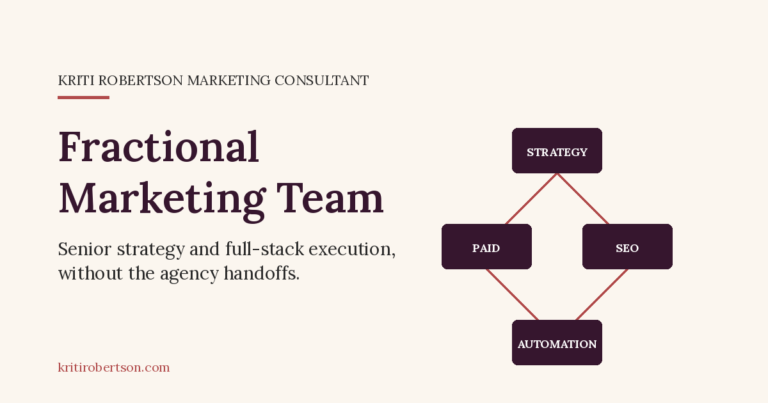
What a fractional marketing team actually is
A fractional marketing team is a small group of senior specialists who run your marketing as if they were your in-house department, for a fraction of the hours and a fraction of the payroll. One person owns the strategy. The same person, or one or two others sitting beside them, runs the channels. You get a head of marketing, a paid media lead, an SEO lead and the automation work, without four salaries, four recruitment fees and four sets of benefits.
I get asked about this model almost every week now, usually by a founder who has already been through two or three agency retainers and is trying not to make the same mistake a fourth time. So I want to be precise about what a fractional marketing team is, what it is not, and when it is the wrong call. I would rather you read this and decide against it than sign something you do not understand.
The short version: a fractional marketing team is the seniority of a marketing director and the hands of a full department, shared across a small number of businesses. It is not an agency. And the difference is not semantics. It is the entire reason the model works.
The agency retainer keeps failing the same way
Almost every business owner who comes to me has already spent thousands with agencies or freelancers. The pattern repeats so reliably that I can describe it before they tell me. A senior person pitched the account. A junior account manager runs it. The Meta ads sit with one team, the SEO with another, the email with a third, and none of them have seen each other’s numbers. Every month a PDF arrives celebrating impressions and clicks, and every month the founder looks at the bank balance and cannot find the revenue those clicks were supposed to become.
That is not a bad agency. That is the agency model working exactly as designed. The economics only hold if senior people sell and junior people deliver, and the reporting only survives if it measures activity instead of outcomes. I know this because my own positioning did not come from a branding exercise. It came from a client I still work with today, who hired a large agency with glowing reviews and high-profile case studies, and received a substandard service. Watching what that experience did to them is the moment I decided Kriti Robertson Marketing Consultant would be the opposite of it. Not an agency. A consultant who owns the whole stack, is transparent about the numbers, and brings senior thinking to the implementation rather than delegating it.
A fractional marketing team fixes the two structural problems at once. There is no handoff between the person who sells and the person who delivers, because they are the same person. And there is no channel silo, because one brain is holding the Meta ads, the organic search and the email flows at the same time and can see where money is leaking between them.
What the numbers say about senior marketing leadership
The instinct, once a business reaches a certain size, is to hire a full-time head of marketing and build a department underneath them. It is worth looking at how the largest companies in the world actually behave before you copy them.
Spencer Stuart’s 2025 CMO Tenure Study found that only 329 of the Fortune 500, 66 percent, had a C-suite marketing leader in 2024, and that the average tenure of those who did was 4.3 years (Spencer Stuart, 2025). Read that again. A third of the Fortune 500 run without a full-time CMO at all, and the ones who have one replace them roughly every four years, with all the recruitment cost, ramp-up time and strategy churn that implies.
If businesses with billions in revenue are cautious about carrying a permanent senior marketing salary, a company doing two or five or ten million has even less reason to feel it must. What that company needs is the judgement of a strategic marketing consultant applied consistently to its numbers. It does not need to fund a full department to get it. That is the gap a fractional marketing team fills, and it is why the model has stopped being a workaround and become a deliberate choice for founders who want senior growth strategy consulting without the fixed cost.
The maths is simple once you separate the two things you are paying for. You are paying for judgement, which is expensive and should be. And you are paying for execution, which should be as lean as the channels allow. A full-time hire bundles both into one salary whether you need forty hours of judgement a week or not. A fractional arrangement lets you buy the judgement at the level you need and keep the execution tight. I went through the salary arithmetic in more detail in my post on the part time CMO model, so I will not repeat it here.
How I run one: a headcount of two, on purpose
Kriti Robertson Marketing Consultant, KRMC for short, is a marketing consultancy with a headcount of two. I run strategy, paid channels, SEO and everything client-facing. Surbhi runs content, social, publishing and design coordination. Between two people, that is the full stack an agency would spread across eight, plus a project manager to manage the project managers.
Small is not a limitation here. It is the mechanism. Nothing gets lost in handoffs because there are no handoffs. The person who wrote the strategy is the person checking the conversion tracking. When a client hears that they get me and not a junior account manager, that is literally true. All strategy and client-facing work is mine alone, and the reason that is sustainable is Surbhi running the machine behind it, QA-ing every link before anything goes live and checking every piece of design against the brand guidelines.
This is also why I cap the Full-Stack Strategic Retainer at three clients. A fractional marketing team only works if the senior person is actually in your account every week, looking at your Meta campaigns, your search rankings and your automation flows as one system. The moment I took a fourth client, I would have to hire a junior to sit between me and you, and I would have rebuilt the agency model I set out to replace.
I learned the shape of this the hard way. When I started KRMC I sold a strategy-only session: I would clarify your marketing, hand you the plan, and you would implement it. A few client conversations changed my mind. Business owners are too busy running their businesses to think about their own marketing, let alone execute it. They did not want guidance. They wanted someone they could trust and hand the whole thing to. So I rebuilt the consultancy around done-for-you strategy plus implementation, which is exactly what a fractional marketing team is.
What the first ninety days should look like
Founders almost always want to talk about scaling first. More ad spend, more content, more channels. I will not propose scaling before I have proposed fixing, because scaling a broken funnel just means losing money faster. On a recent ecommerce engagement I structured the roadmap in three deliberate phases, and I now use the same shape with nearly every client.
Fix comes first, in months one and two. Conversion tracking, the product catalogue, the basic mechanics of the checkout or the enquiry form. I audited a Meta Ads account last year that looked healthy on the surface: consistent spend, decent engagement, retargeting audiences already built. But every campaign objective was reach, profile visits or link clicks, and the pixel only tracked page views. Meta had no idea what a valuable customer looked like for that business, so it was optimising for attention instead of revenue. Busy is not the same as working. I would rather see a quiet ad account with three clean conversion events than a loud one with none.
Focus comes next, in months two to four. The data from the fix phase will show you the one search intent or the one audience that is already converting. You own that completely before you go anywhere else. This is where working with a marketing strategy consultant who also runs the channels pays for itself, because the strategy is being written by the person who can see the conversion data, not by someone reading a summary of it.
Grow is the third phase, and only the third. Alongside it I set one hard rule: any ad spend that cannot beat a calculated breakeven cost per acquisition gets paused, no exceptions and no “let’s give it another month”. That rule alone has saved clients more than any creative idea I have ever had.
What the channels look like inside one team
The advantage of a fractional marketing team over a collection of freelancers is not that the individual work is better. It is that the work is connected. Here is what that means in practice.
Paid media and search are run against the same conversion events, so I can see whether a Meta campaign is bringing in customers or just bringing in people who then search your brand name and get counted by the organic SEO consultant as an organic win. Email flows are built by the same person who wrote the ad, so the message someone clicked on is the message they receive. The automation, which I treat as a core channel rather than an add-on, is designed by the marketing automation specialist who also knows which leads the sales team actually wants, because I asked.
For a local operator the same principle applies at a smaller scale. A local SEO consultant who has also seen your ad data knows which service lines are worth building Google Business Profile content around, and which ones only look popular. I scored a client’s profile earlier this year and their reviews came out excellent, high volume and strong ratings. The rest of the profile scored 26 out of 60: wrong category, no posts, no products, photos several years old, zero keyword alignment. Reviews build trust once someone is already looking at you. They do nothing to help someone find you in the first place. That is the kind of thing a siloed reviews vendor never tells you, because it is not their job to look.
When a fractional marketing team is the wrong call
I would be doing you a disservice if I pretended this fits everyone. It does not, and I turn down more of these conversations than I accept.
If you have not yet proven that anyone will pay for the product, you do not need a fractional marketing team. You need sales conversations and a very cheap way to test messages. If you have no conversion tracking and no budget to spend on channels once it is fixed, a retainer of any kind will spend the first two months building a measurement system you cannot then use. And if you are a brick-and-mortar business with a small budget and an urgent problem, a fixed-fee sprint will serve you far better than a monthly arrangement. That is precisely why I built the Local SEO Sprint: a client once sat down with me expecting a full strategy proposal, and within ten minutes it was obvious they needed fast fixes and a properly optimised Google Business Profile, not market research. They did not even have a website yet. Sometimes you do what the budget allows, and you do it well.
The model is right for you when you have a product that sells, a revenue base that can fund real channel spend, and a leadership team that has grown tired of being the only people in the building who know what the marketing is for. That is the founder I built KRMC for: someone who has outgrown fragmented retainers and wants one senior business marketing consultant accountable for the whole funnel.
Questions to ask before you sign
Whether you talk to me or to someone else, these are the questions I would want answered before paying anyone a monthly fee to be your fractional marketing team.
Ask who will actually be in your ad account on a Tuesday afternoon, by name, and whether that is the same person who pitched you. Ask how many other clients they carry at the same time, because the honest answer tells you how much of their judgement you are really buying. Ask what they will report on, and walk away if the first answer is reach or engagement rather than cost per acquisition, pipeline and revenue. Ask what happens in the first thirty days, and be suspicious of anyone who wants to launch campaigns before they have looked at your tracking. And ask what they will refuse to do. A consultant with no red lines is a consultant who will spend your money on anything you suggest.
I will audit your funnel in week one and tell you exactly where the leaks are. If the honest finding is that you do not need me yet, I will tell you that too, and point you to the small business consultant services or the templates that fit where you are. A fractional marketing team is only worth paying for if it makes the rest of your marketing spend work harder. If it does not, it is just a cheaper way to run the same leaky bucket.
Bespoke full-stack marketing strategy for elite growth. That is the standard, and it is the reason I keep the team small enough to meet it.