Kriti Robertson is an independent business marketing consultant based in Hong Kong. She works with a small, capped roster of business owners who are tired of agencies that sell tactics before they have a strategy. Her work covers marketing strategy, organic SEO and a 14 day Local SEO Sprint for businesses that need customers now.
Fractional CMO vs Interim CMO: 5 Differences That Decide Which One You Need
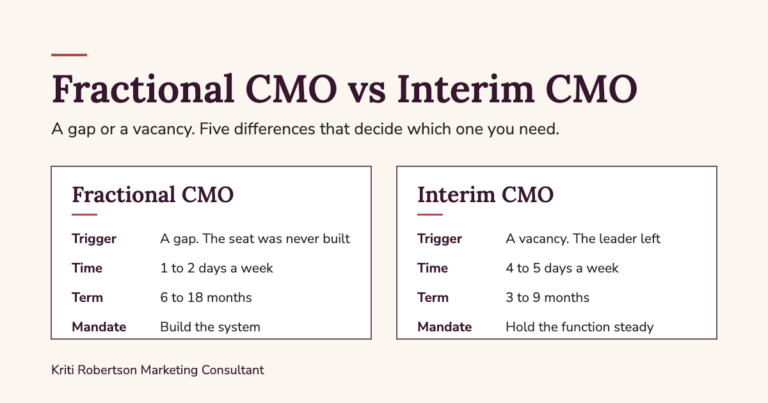
Fractional CMO vs interim CMO: the short answer
The fractional CMO vs interim CMO decision looks like a choice between two job titles. It is a choice between two problems. An interim CMO fills a seat that has gone empty. A fractional CMO fills a gap in a business that never had the seat, or does not need it five days a week.
Get it wrong and you pay for the wrong thing. You put a full-time caretaker into a business that needed two days a week of senior direction. Or you buy two days a week for a marketing department that needed someone in the building every morning.
I am Kriti Robertson, and I run Kriti Robertson Marketing Consultant (KRMC), a premium one-woman, full-stack consultancy. I am not an interim CMO and I will not pretend to be one. That is exactly why I can be candid about when you need an interim, when you need a fractional leader, and when you need neither.
What an interim CMO actually does
An interim CMO is a full-time, temporary executive. They step into an existing marketing function when the permanent leader has resigned, gone on leave, or been moved on. The usual shape is four to five days a week for three to nine months.
They manage the team, own the budget, sit in the leadership meeting and keep the campaigns running. Often they help recruit their own successor. The brief is continuity. A good interim is not there to reinvent your positioning. They hold the function steady, fix what is urgent, and hand over a clean desk.
That only works if there is something to hold. An interim CMO needs three things to already exist: a team, a budget and a seat at the table. If you do not have those, you are not looking for an interim.
What a fractional CMO actually does
A fractional CMO is a part-time, ongoing executive. One to two days a week is typical, for six to eighteen months, usually alongside two or three other clients. I have covered the model in more detail in my guides to the part time CMO and the outsourced CMO.
The brief is to build. A fractional CMO sets the strategy, chooses the channels, hires or directs the people who execute, and reports to the founder on pipeline and revenue. They fit a business with real revenue and no senior marketer, where a full-time executive salary would be out of proportion to the size of the marketing budget.
The trade-off is presence. Two days a week is enough to direct. It is not enough to manage six people through a product launch.
Fractional CMO vs interim CMO: 5 differences that matter
1. The trigger
You hire an interim CMO because somebody left. You hire a fractional CMO because nobody was ever there. One is a vacancy. The other is a gap. Name which one you have before you take a single call.
2. Time in the business
Interim means four to five days a week. Fractional means one to two. Count your direct reports. If six marketers need decisions every day, two days a week is not leadership. It is a weekly visit.
3. The mandate
An interim holds. A fractional builds. Ask an interim to rebuild your whole go-to-market in four months and you will get a plan nobody stays long enough to own. Ask a fractional to babysit a team through a restructure and you are wasting a strategist.
4. How you pay
Interims usually charge a day rate for a fixed term. Fractionals usually charge a monthly retainer. The interim costs more per month for a plain reason: you are buying more days. If you want the numbers behind senior marketing fees, I have broken down what a marketing consultant costs separately. Compare cost per outcome, never cost per day.
5. What is left when they leave
A good interim leaves a stable team and a named successor. A good fractional leaves a strategy, a working system and people who can run it without them. Ask both the same question in the first meeting: what will I own when you are gone?
If the answer is a slide deck, keep looking.
Why the interim seat keeps opening
The interim market exists because the CMO seat empties often. Spencer Stuart’s CMO Tenure 2026 study puts average CMO tenure at S&P 500 companies at 4.1 years, against 5.0 years across the C-suite as a whole. The same study found that 38% of sitting CMOs were hired from outside the company.
Put those two numbers together. The seat opens roughly every four years, and in more than a third of cases the replacement comes from an external search that takes months. That window is where an interim CMO earns the day rate. Someone has to run a department while the board interviews.
Now look at who that data describes. S&P 500 companies. Businesses with marketing departments, budgets and boards. If you run a 15-person company, you do not have a CMO seat that keeps emptying. You have a founder doing the marketing at 10pm. That is not a vacancy, and an interim is the wrong answer to it.
The mistake I see before either hire
Most founders who ask me about fractional and interim leaders have skipped a step. They are choosing a title before they have defined the problem.
I have seen too many businesses launch a website, hire a Meta Ads agency, hire an SEO agency, spend thousands on Google Ads, and then ask six months later why it is not working. When I ask what success looks like, or who they are trying to reach, they often do not have an answer. A senior title on top of that does not fix it. It only makes the guessing more expensive.
So here is the test I would apply to any marketing leader, interim or fractional, in their first 90 days. On a recent ecommerce project I structured the roadmap in three deliberate phases. Fix in months one and two: tracking, catalogue, basic conversion mechanics. Focus in months two to four: own the one search intent the data had already proved was converting. Only then, Grow. I set one hard rule alongside it. Any ad spend that cannot beat a calculated breakeven cost per acquisition gets paused. No exceptions.
If the person you are about to hire wants to talk about scaling before they have asked to see your tracking, that tells you what the next six months will look like. Busy is not the same as working.
When you need neither
Here is the part most comparison articles leave out. Many of the founders weighing a fractional CMO against an interim CMO do not need a CMO of any kind. They need the thinking and the doing from the same person.
I learned this the direct way. When I started KRMC I sold strategy-only clarity sessions. I would set the direction and the client would implement. A few client conversations changed my mind. Business owners are too busy running the business to execute their own marketing plan. They did not want guidance. They wanted someone they could trust to take the whole thing off their desk. So I rebuilt the consultancy around strategy plus implementation.
That is the limit of the fractional model for a small company. A fractional CMO directs. Somebody still has to build the Meta campaigns, fix the technical SEO and wire up the automation. In the agency model that work is split across three retainers, each with a junior account manager and a monthly PDF. Nobody owns the result.
As a full stack digital marketing consultant, I own it end to end. My Full-Stack Strategic Retainer covers Meta ads, SEO and AI automation, and I cap it at three clients so the senior attention is real. In practice that means I act as your marketing strategy consultant, your organic SEO consultant and your marketing automation specialist, with one plan and one set of numbers.
If you run a local, bricks-and-mortar business, you may not even need a retainer. My Local SEO Sprint is a fixed-fee, 14-day Google Business Profile intensive, with four slots a month. Hiring a local SEO consultant for two weeks is a very different commitment from hiring an executive for nine months, and for a lot of local operators it is the one that moves revenue first.
A business marketing consultant who implements is not a cheaper CMO. It is a different answer, for a business that has no team to delegate to yet. A freelance marketing consultant or a strategic marketing consultant can be the right call for the same reason, provided they do the work and not only the workshop.
How to choose in 10 minutes
Answer these four questions in order. Stop at the first yes.
- Did your marketing leader just leave, with a team still in place? Hire an interim CMO. Start the permanent search in the same week.
- Do you have five or more marketers who need daily decisions? You need full-time leadership. Interim now, permanent next.
- Do you have steady revenue, a small team or reliable freelancers, and no senior marketer? Hire a fractional CMO for one to two days a week.
- Do you have no team to direct, and need the strategy and the execution together? Hire a consultant who implements, and judge them on pipeline and sales.
If none of the four fits, your problem may not be marketing at all. I have had clients arrive asking for campaigns when the real issue was operations: manual processes, broken links in the customer journey, systems that did not talk to each other. I tell them so in the first conversation, because sending more demand into a business that cannot handle it is a waste of their money.
Fractional CMO vs interim CMO: common questions
Is an interim CMO more expensive than a fractional CMO?
Per month, yes, because you are buying four or five days a week instead of one or two. Over the full engagement it depends on length. Three months of interim cover can cost less in total than eighteen months of fractional leadership.
Can a fractional CMO step in as an interim?
Sometimes, if they can clear their other clients. Most cannot at short notice. Ask about availability before you ask about experience.
How long should each engagement last?
An interim engagement should end when the permanent hire starts, usually within three to nine months. A fractional engagement should have a review point at six months, with revenue and pipeline numbers on the table, not activity.
The verdict
Fractional CMO vs interim CMO comes down to one question. Is the seat empty, or was it never built? An empty seat with a team around it needs an interim. A growing business with no senior marketer needs a fractional. A founder with no team and no time needs someone who will do the strategy and the work.
Hire for the problem, not the title.
If you are not sure which problem you have, that is the right place to start. I will audit your funnel in week one and tell you exactly where the leaks are. You can see how that has worked for other businesses in my Kriti Robertson Marketing Consultant case studies, or look at my services and decide which one fits.