You already know the marketing works. The problem is that the person holding the budget does not, and every conversation so far has ended with “let us revisit it next quarter.” So let me be direct about how to convince boss to invest in marketing: you stop selling activity and start selling arithmetic. Budget holders do not reject marketing because they hate marketing. They reject it because nobody has shown them the line that runs from a pound spent to a pound earned.
I have sat on both sides of this table. I have been the consultant asking a founder to commit real money to a channel they could not see working yet, and I have watched marketing managers get turned down flat because they walked in with a slide full of impressions. What follows is the case I would help you build if you were my client.
Why your boss keeps saying no
Start by being honest about what your boss is actually hearing. Most people pitch a marketing budget by leading with reach: followers, impressions, engagement, website visits. To someone responsible for a P&L, those words sound like cost with no counterpart. They are not being short-sighted. They are being asked to fund something described entirely in a language that never touches revenue.
Almost every business owner I take on has already been burned by exactly this. They have spent thousands with agencies or freelancers who reported diligently on vanity metrics and delivered nothing to the bottom line. By the time they reach me they are slow to trust, even when what I am saying makes complete sense. Your boss may carry the same scar tissue: if the last agency showed a rising follower count while the pipeline stayed flat, more marketing now sounds like more waste, faster.
So the first move isn’t a bigger ask. It’s a better frame. You have to separate what you want to do from what it will produce, and you have to lead with the second one.
The common objections you will have to answer first
Before you build the case, write down what you already know the pushback will be. Every conversation of this kind stalls on the same three lines, and nothing you present later will convince anyone while they are still hanging in the air.
“We tried a marketing agency and nothing happened”
This is the most familiar one, and it is usually fair. Do not defend the agency. Ask what was measured, and you will almost always find that nobody agreed what success looked like before the company spent anything. That is your opening: the problem was not the investment, it was the absence of a target.
“We cannot afford it this year”
What that usually means is the company cannot afford to lose the money. Those are different challenges, and the second one has a fix – a smaller first commitment with a defined stop point, which I come back to below.
“How will we know it worked?”
Answer this before it is asked. Name the two or three numbers you will report, say when you will report them, and say what result would make you recommend stopping. Executives rarely expect certainty. They expect you to have thought seriously about being wrong.
Lead with the number, not the activity
Here’s the reframe. Walk in with a projected return, not a proposed campaign. Your boss doesn’t need to care whether you run Meta ads or write email sequences. They need to see that £1 in comes back as more than £1 out, and roughly when.
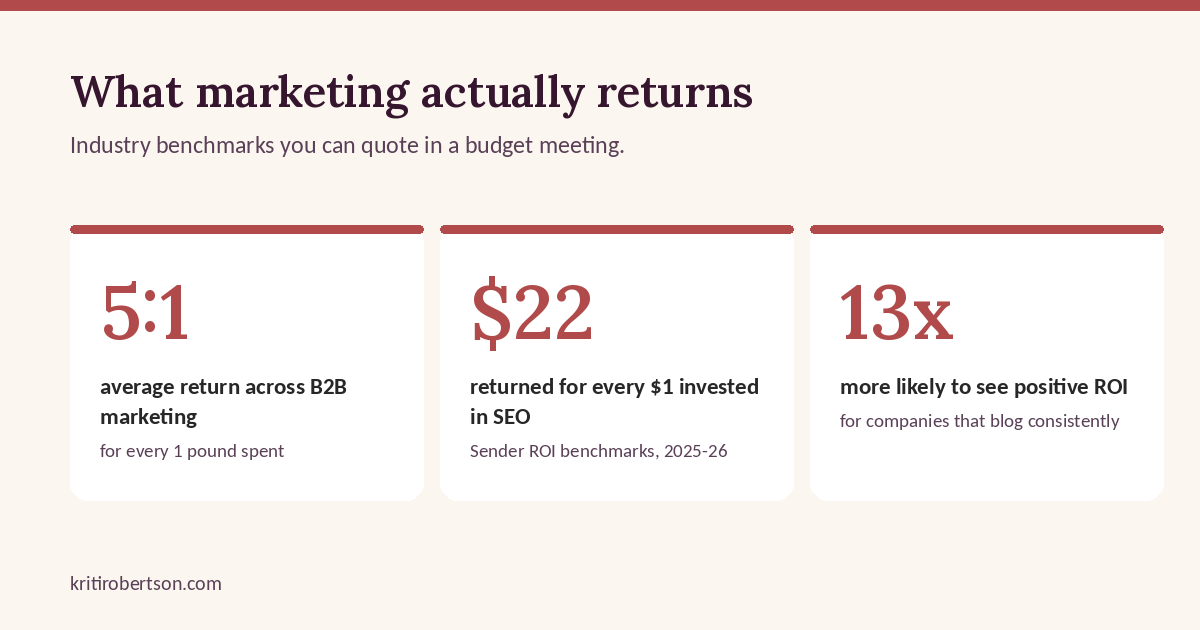
The data backs you up, and it is worth quoting. Across B2B, marketing returns an average of around 5:1. SEO in particular is documented at roughly $22 back for every $1 invested, according to Sender’s 2025-2026 marketing ROI benchmarks, and consistent blogging correlates with 13x more positive ROI than not blogging at all. These are not my numbers. They are everybody’s, and they exist so people like you can point at them.
There is a broader point that lands well with cautious leadership. When Harvard Business Review studied thousands of companies across multiple downturns in its “Roaring Out of Recession” analysis, the businesses that kept investing while competitors cut came out measurably stronger. Pulling marketing spend feels like discipline, but it usually just hands market share to whoever held their nerve. If the instinct you are up against is to wait for a calmer quarter, that is your counter-argument.
The market is already moving in your direction. Nearly half of small businesses – 49% – planned to increase their marketing budgets in 2025, with only 16% cutting, per analysis of small business budget data. You are not asking for something reckless. You are asking not to be the one company standing still.
Build the North Star before you ask for the money
Now, a number on its own isn’t enough, because your boss’s very next question will be: “return from what, exactly?” This is where most pitches collapse, and it’s the part I care about most.
If there is one marketing hill I will die on, it is that strategy comes before execution – not because strategy is exciting, but because without it every marketing activity is a guess. I have watched too many businesses launch a website, start posting, hire a Meta ads agency, hire an SEO agency, and spend thousands on Google ads, then ask six months later why none of it is working. When I ask what success was supposed to look like, they often cannot answer.
My version of strategy is not a hundred-page document. It is a North Star: one page that defines your target audience, positioning, messaging, USPs, competitors, and a twelve-month roadmap. That document becomes the filter for every pound you spend, and it turns your request from “give me a marketing budget” into “give me the means to reach these people, with this message, toward this twelve-month outcome, measured this way.” One is a leap of faith. The other is a plan a finance-minded person can say yes to.
If you don’t yet have that clarity, that’s the thing to build first, whether internally or with a marketing strategy consultant who can pressure-test it. Good growth strategy consulting exists precisely to give you a defensible answer to “why this, why now, why this much.”
Be specific about what the money buys
“Marketing” is too vague to approve. Break the ask into the two or three things your North Star says matter most, and price them separately, so one line can be approved without approving all of them.
For most of my clients that starts with content marketing: a blog that answers what buyers are already searching for, the SEO work that makes that content findable, and email marketing to convert the traffic it earns. Content marketing is slow, and I say so plainly – but it compounds, and it is the only spend that keeps working after you stop paying for it. Write your content marketing goals into the same page: how much content, on which topics, aimed at which stage of the decision.
Paid platforms belong here too, as the fast half of a pair rather than the whole approach. Ads buy data quickly; content buys compounding lead generation slowly. A proposal funding both in sensible proportion is easier to defend than one betting everything on either.
Pick metrics your boss actually respects
Once you have a North Star, choose how you’ll report against it — and choose deliberately. This is where you break from whatever agency taught your boss to distrust marketing in the first place.
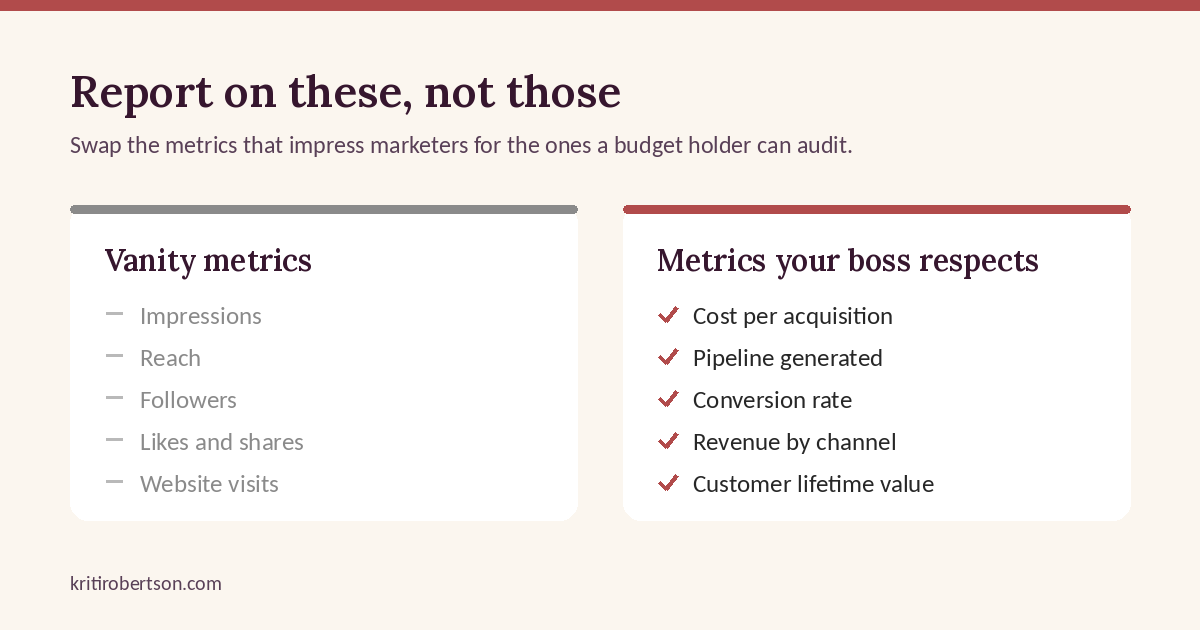
I never celebrate clicks or impressions, and I would tell you not to either. Followers are a vanity metric, and your CFO can spot low engagement behind a big number as easily as your customers can. Tie the proposal to metrics that map to revenue: cost per acquisition, pipeline generated, conversion rate, revenue by channel, customer lifetime value. Promising to report in those terms promises something your boss has probably never had from marketing – accountability they can audit.
Set the bar in advance, too. On client work I hold a hard rule: pause any spend that cannot beat a calculated breakeven cost per acquisition. No exceptions. Offer your boss that same discipline. Telling them upfront that you will kill anything failing a defined threshold does more to unlock a budget than any projection, because it caps the downside. You are not asking anyone to trust marketing forever. You are asking them to fund a test with a built-in stop-loss.
Start smaller than you think, then let results argue for you
You don’t have to win the whole budget in one meeting. Often the smarter play is to ask for a contained first phase — enough to prove the mechanism, not enough to frighten anyone.
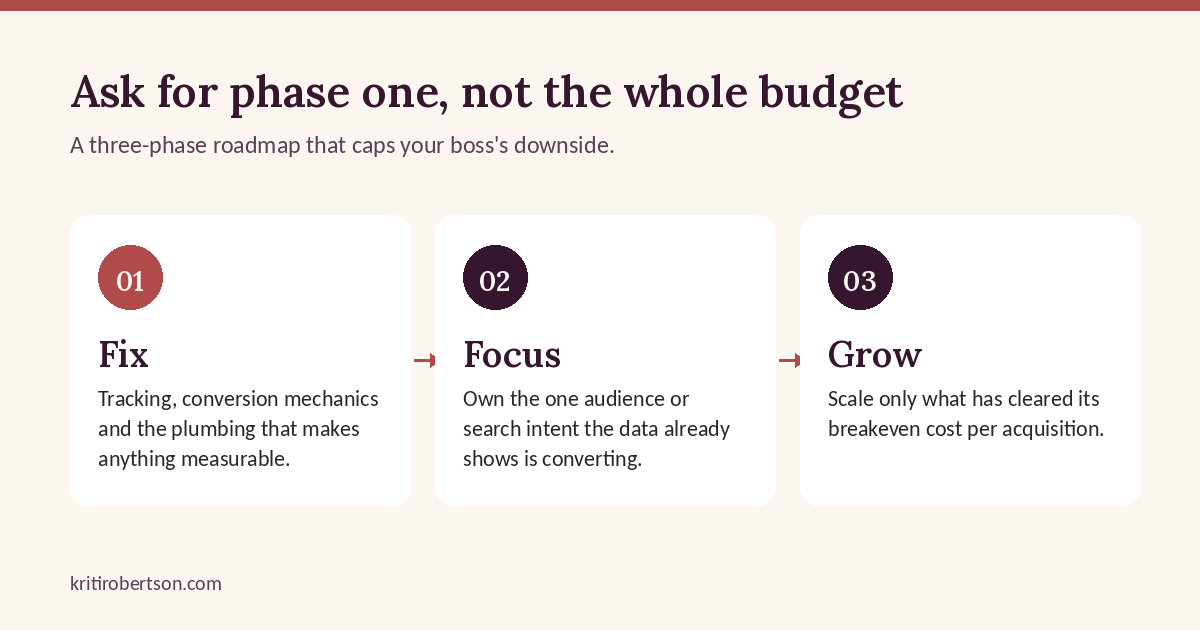
I structure client roadmaps in three deliberate phases: fix, focus, grow. Fix comes first – tracking, conversion mechanics, the plumbing that lets you measure anything at all. Then focus – own the one search intent or audience the data already shows is converting. Only then grow. Scaling a broken funnel just gets you a bigger broken funnel, faster. For your pitch this sequencing is a gift: “let me spend a modest amount getting our measurement right and proving one channel converts, then we scale what works” is close to impossible to refuse, because the first phase de-risks the second.
That first phase also gives you the thing that ends this debate permanently: your own data. External benchmarks open the door, but a single quarter of your own numbers – leads that became revenue, a channel that beat its breakeven – closes it.
Put the whole ask on one page
Do not build a forty-slide presentation. One page, sent the day before so it gets read without you in the room, does more work than anything you can say out loud.
Mine follows the same five steps every time: the business goals the spend serves, who you are trying to reach and what you will say to them, what the spend buys, the numbers you will report, and the point at which you would stop. That is the entire guide. If it will not fit on a page, the thinking is not finished.
Add evidence sparingly. One or two case studies from a company your boss already rates, or success stories from your own industry, land harder than a wall of research. And if you have any analytics at all – a thin trickle of organic traffic, a handful of enquiries through the website – lead with your own data. Nothing you borrow will convince as well as something you can point at.
Match the ask to what the business can actually handle
One caution, because I’d be a poor business marketing consultant if I skipped it. More marketing is not always the right answer, and pretending it is will cost you credibility.
Marketing accelerates growth, but it also accelerates problems. If your operations are broken – manual processes, disconnected systems, a leaky customer journey – great marketing just helps more people experience those problems. I once took on a client who wanted marketing help when their real constraint was operational, and I flagged it plainly rather than pour demand into a business that could not handle it. If part of the hesitation you are meeting is that nobody is ready to absorb more customers, they may be right, and acknowledging it makes every other point you raise more believable. Sometimes the highest-return move is tightening the systems first, which is where a marketing automation specialist or a disciplined email marketing consultant earns their fee before you spend a penny on reach.
A worked example you can steal
Say you want £12,000 over six months. The shape of the ask that works sounds like this: “This company converts about one in five qualified leads, and our average sale is £4,000. Two extra sales pay for the whole investment. I am asking for £12,000 to fund content and one paid channel, reporting cost per acquisition monthly, and I will pause anything that cannot beat a £900 breakeven.”
Nothing in that is a marketing idea. It is arithmetic with a stop-loss attached, and it is the version a finance-minded person can approve in a sentence. Share the workings, not just the conclusion – the moment someone can check your maths themselves, you stop being a person asking to be trusted and become a colleague with a proposal.
How to Convince Boss to Invest in Marketing: The Pitch That Works
So, pulling it together. If you want to convince your boss to invest in marketing and actually get a yes, stop leading with what you will do and start leading with what it returns. Frame the ask around a clear return, backed by benchmarks your boss can verify. Build a North Star so the spend has a destination. Report on revenue metrics, not vanity ones, and set a breakeven rule that caps the downside. Ask for a small, measurable first phase instead of everything at once. And be honest about whether the company can handle what you are about to send its way.
Do that, and you’re no longer the person asking to spend money. You’re the person showing your boss where the growth is and offering a low-risk way to go get it. That’s a conversation budget holders say yes to — because you’ve finally spoken to them in the only language a budget meeting respects, which is money in versus money out.
If you’d rather not build that case alone, that’s the kind of thing I do: audit where the leaks are, put a North Star and a set of honest numbers behind the ask, and give you the plan your boss can’t easily say no to.