Kriti Robertson is an independent business marketing consultant based in Hong Kong. She works with a small, capped roster of business owners who are tired of agencies that sell tactics before they have a strategy. Her work covers marketing strategy, organic SEO and a 14 day Local SEO Sprint for businesses that need customers now.
Is PPC or SEO More Measurable and Quantifiable? An Honest Answer From a Consultant
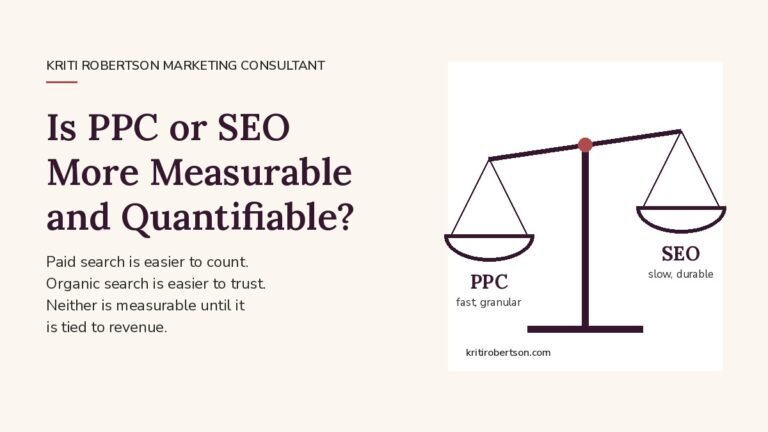
Is PPC or SEO more measurable and quantifiable? I get asked this in almost every first conversation with a founder who has been burnt by an agency. They have usually been told that paid search is the “accountable” channel because every dollar and every click shows up in a dashboard, and that SEO is the slow, fuzzy one you fund on faith. I disagree with both halves of that. Having run Meta ads, Google Ads and SEO side by side for the same clients, my honest answer is this: PPC is easier to count. SEO is often easier to trust. Neither is measurable until you have done the unglamorous work of connecting it to revenue. This post explains what I mean, with the numbers that back it up.
The short answer
If you want a one-line verdict, here it is. PPC gives you faster, more granular data. SEO gives you slower, more durable data. Whether either channel is genuinely quantifiable depends almost entirely on the tracking underneath it, not on the channel itself.
That is not a hedge. It is the diagnosis I give after auditing an account, and it is the reason the question “is PPC or SEO more measurable and quantifiable” is usually the wrong question. The right question is: can I trace this channel to a lead, a booking or a sale, and can I do it the same way every month? When I run that test, PPC and SEO pass or fail for the same reason. The pixel is wrong, the forms are not tagged, the phone calls are not recorded, or the business is counting the wrong thing.
What “measurable” actually means
Before comparing the channels I want to pin down the word, because agencies stretch it to cover almost anything. When I say a channel is measurable, I mean three things are true.
First, it is tracked to a business outcome. Not a click, not an impression, not a “session”. A form submission, a call that lasted more than 60 seconds, a booked consultation, a transaction with a value attached.
Second, that outcome is attributed in a way the business owner understands and would defend to their accountant. If the attribution model changes next quarter and the numbers move by 40 percent, the channel was never really measured. It was estimated.
Third, the measurement is repeatable. The same report, built the same way, on the same day each month. If you need a different spreadsheet every time to make a channel look good, it is not quantifiable. It is storytelling.
Hold those three tests in mind, because PPC and SEO fail them in different places.
Why PPC looks more measurable than it is
Paid search has the reputation for accountability because the platform hands you a number for everything. Spend, clicks, cost per click, conversions, cost per conversion, return on ad spend. It feels like accounting.
Here is the problem I see over and over. I audited a Meta Ads account that looked, on the surface, like a healthy account. Consistent spend, decent engagement, retargeting audiences already built. Then I opened the campaign objectives. Every single one was reach, profile visits or link clicks, and the pixel only tracked page views. Meta had no idea what a valuable customer looked like for this business, so it was optimising for attention, not revenue. The dashboard was full. The bank account was not. Busy is not the same as working, and I would rather see a quiet ad account with three clean conversion events than a loud one with none.
That account was “measurable” in the sense that it produced hundreds of numbers a week. It was not quantifiable in any sense a founder should care about, because none of those numbers connected to money.
The wider data backs this up. Nielsen’s Marketing ROI Blueprint, published in October 2025, found that 85 percent of marketers are confident in their ability to measure ROI, yet only 32 percent actually measure it holistically across their channels. Read that gap again. More than half of the people who feel confident about their numbers are measuring one channel at a time, in that channel’s own dashboard, on that channel’s own terms. That is exactly how paid search gets credit it did not earn. Google Ads will happily attribute a sale to the branded search ad someone clicked after reading your blog, finding you on Maps and getting a referral from a friend.
So yes, PPC is countable. But the thing being counted is often the last click in a journey that SEO, word of mouth and your Google Business Profile started.
Why SEO looks less measurable than it is
SEO has the opposite reputation, and I think it is mostly undeserved. The idea that organic search is a black box comes from how agencies have historically reported it: a monthly PDF of ranking positions and a traffic graph going up and to the right. Rankings are not revenue. Traffic is not revenue. If that is the only report you have ever seen from an SEO provider, of course it feels unquantifiable.
Set up properly, organic search is one of the most honest channels I work with. Google Search Console gives you query-level data that does not depend on cookies or consent banners. GA4 tells you which landing pages organic visitors arrive on and what they do next. A form with a hidden “source” field tells you which organic page produced the enquiry. Your Google Business Profile tells you how many calls, direction requests and website clicks it generated this month, and a focused 14-day sprint on that profile shows up as a step change in those numbers within weeks, not quarters. I scored one client’s profile recently as a local SEO consultant. Their reviews were excellent, high volume and strong ratings. The rest of the profile scored 26 out of 60: wrong category, no posts, no products, photos two to six years old, zero keyword alignment. Reviews build trust once someone is already looking at you. They do nothing to help someone find you in the first place, and every one of those gaps is a measurable fix with a before-and-after number attached. That is not fuzzy. That is a number with a date on it.
The other thing SEO has in its favour is that its data compounds. A paid search report from March tells you nothing about April unless you spend again. An organic page that ranked in March is still producing leads in September, and you can see the trend line for the whole period. For an organic SEO consultant the measurement challenge is not that the data is missing. It is that the payback window is longer than one billing cycle, and most reporting is built around billing cycles.
Where SEO genuinely loses on measurability is attribution of assisted conversions. Someone reads three of your articles over six weeks, then types your brand name into Google and converts. Search Console will count that as a branded search. GA4 may call it direct. The content did the work and gets none of the credit. That is a real limitation and I am not going to pretend otherwise. I handle it by treating branded search growth as a key performance indicator in its own right, because it is one of the few signals that is immune to cookie loss.
You cannot trust a baseline you have not cleaned
Whichever channel you lean towards, this is the step most businesses skip, and it is where I start every engagement as a business marketing consultant. Before I build a strategy, I build a baseline, and I do not take the analytics dashboard at face value.
On one ecommerce account the traffic numbers included a chunk of users from countries with no business reason to be visiting the site. Almost certainly internal or team traffic, inflating the real picture. The ad accounts were also billing in a different currency to the reporting currency, which would have skewed every cost-per-acquisition number if I had not converted it first. If you build a 12-month plan on top of dirty numbers, every decision after that is wrong, and it does not matter whether the channel was PPC or SEO. Both were being measured. Neither was being measured correctly.
Cleaning a baseline is boring work. Exclude internal IPs. Reconcile currencies. Check that every conversion event fires once, not twice. Confirm the thank-you page is not indexed and picking up organic visits that look like conversions. It takes me most of week one, and it is the reason my clients can trust the numbers in week twelve.
How I measure both in one system
At Kriti Robertson Marketing Consultant (KRMC), I run paid and organic for the same client from the same dashboard, and I think this is the single biggest reason the measurability debate disappears for them. The agency model splits these channels into silos. A PPC team reports ROAS. An SEO team reports rankings. Nobody reports on the business, and the founder is left trying to reconcile two PDFs that were never designed to be compared. This is one of the reasons I wrote about why marketing strategies must line up with SEO strategies, because the measurement problem and the strategy problem are the same problem.
Here is the system I use, and it is deliberately simple.
Every channel reports in the same unit. For a service business that unit is qualified enquiries. For ecommerce it is first-order revenue. Clicks, impressions and rankings are diagnostic metrics I look at to fix things, not performance metrics I report to a client.
Every conversion has a source. Forms carry a hidden field that captures the landing page and channel. Calls are tracked with a swap number per channel. Bookings are tagged. If a conversion cannot be traced, it is logged as “unknown” rather than quietly handed to the paid channel because that is where the platform put it.
Paid spend has a hard ceiling. I calculate a breakeven cost per acquisition for every client before any ad goes live, and any campaign that cannot beat it after a fair test gets paused. No exceptions, no “let us give it one more week”. That rule only works because the conversion tracking underneath it is clean, which brings us back to the baseline.
Organic gets a leading indicator and a lagging indicator. The leading indicator is non-branded impressions and clicks in Search Console for the pages we are working on. The lagging indicator is enquiries from organic landing pages, measured over a rolling 90 days so a slow month does not panic anyone. I am honest with clients that the lagging number will take a quarter to move. I am also honest that the paid number will stop moving the day they stop paying.
When the client needs the plumbing to do this properly, I set it up myself rather than handing it to a third party, which is the part of my work that falls under being a marketing automation specialist. Lead routing, CRM tagging and the weekly reporting pull are automated once and then left alone. The founder gets one view, every Tuesday, in the same format.
Which one should you fund first
This is where my answer changes depending on who is asking, and I think any honest marketing strategy consultant would say the same.
If you are a local operator with a physical location, fund organic first and specifically your Google Business Profile. It is the most measurable thing in your entire marketing stack, because Google reports calls, direction requests and website clicks directly, and the work pays back inside a month. I built the Local SEO Sprint around exactly this. It is a fixed-fee, 14-day intensive on the profile, four slots a month, and the before-and-after numbers are not open to interpretation. Paid search can come afterwards, once you know what a customer is worth and what you can afford to pay for one.
If you are an established founder with a longer sales cycle and an existing customer base, fund both, but fund the measurement first. One clean month of tracking before any new spend. Then run paid search to learn which offers and search terms convert, and feed what you learn straight into the organic content plan. Paid is the fastest way to find out what people actually want to buy. Organic is the cheapest way to keep selling it to them for the next three years. The two are not competitors. They are two halves of one funnel, and the strongest results in my case studies came from running them together under one strategy rather than letting two providers fight over credit.
If you are a B2B company with a 60 to 90 day sales cycle, be especially sceptical of in-platform PPC reporting. A seven-day conversion window captures a fraction of a quarter-long journey, and the platform will under-report its own impact in some places and over-claim it in others. CRM-based attribution, matched back to first touch, is the only measurement I trust at that cycle length.
The verdict
So, is PPC or SEO more measurable and quantifiable? PPC wins on speed and granularity. You will know within days whether an ad is working, and you can test a hypothesis for a few hundred dollars. SEO wins on durability and honesty. Its data is harder to inflate, it does not depend on a platform marking its own homework, and it keeps reporting long after the work is done.
But both channels fail the measurability test for the same reason, every time I audit them. Nobody connected them to revenue. Nobody cleaned the baseline. Nobody made the reports comparable. That is not a channel problem. It is a strategy problem, and it is usually a provider problem too, because a channel-siloed agency has no incentive to build a view of the business that might show its own channel underperforming.
If you take one thing from this, take this. A channel is only as measurable as the tracking you build under it. Fix the tracking first and the PPC versus SEO debate mostly answers itself, because for the first time you will be comparing the two on the only number that matters: what it costs you to win a customer, and what that customer is worth.
If you would rather have one person own both channels and the measurement that sits underneath them, that is the work I do as a full stack digital marketing consultant and independent SEO consultant. I will audit your funnel in week one and tell you exactly where the leaks are. No PDF theatre, no junior account manager, and no channel getting credit it did not earn.