Kriti Robertson is an independent business marketing consultant based in Hong Kong. She works with a small, capped roster of business owners who are tired of agencies that sell tactics before they have a strategy. Her work covers marketing strategy, organic SEO and a 14 day Local SEO Sprint for businesses that need customers now.
Is SEO Part of Performance Marketing? Yes, If You Measure It Like One
Is SEO part of performance marketing? Ask three agencies and you will get three answers, and all three will be shaped by what each one sells. The paid media shop will say no, SEO is a brand play with a two-year payback. The SEO shop will say yes, then send you a monthly PDF full of rankings and impressions that proves the opposite. The “integrated” agency will say “it depends” and bill you for both.
My answer is shorter. SEO is performance marketing when it is measured like performance marketing, and it is a cost centre when it is not. The channel does not decide. The measurement does. I have audited enough accounts as a business marketing consultant to know that the same site can run SEO as a pipeline engine or as an expensive hobby, and the only difference is what gets tracked and what gets paid for.
This post walks through the definition, the data, and the exact operating rules I use so that organic search earns its place on the same dashboard as Meta and Google Ads.
What performance marketing actually means
Performance marketing has a simple test. You pay for outcomes, you can measure those outcomes, and you can change your spend based on what you measure. Three conditions. Paid search passes all three on day one. You buy a click, you track the conversion, you move budget by Friday.
Strip the definition back to that test and it says nothing about channel. It does not say “ads only.” It says measurable, attributable, adjustable. So the honest question is not whether SEO belongs in the performance marketing category by default. It is whether your SEO passes the three-part test. Most of the SEO I inherit from agencies fails on condition two, measurement, and therefore cannot pass condition three, adjustment.
Where SEO fails the test, as it is usually sold
Here is the pattern I see in nearly every retainer audit. The deliverable is a report. The report shows keyword positions, organic sessions, and a line chart of impressions from Search Console. None of those is an outcome. None of them is tied to a lead, a booked call, or a sale. The client has been paying for 12 or 18 months and cannot tell me how many enquiries organic search produced last quarter, because nobody set up the conversion events that would answer the question.
That is not performance marketing. It is channel reporting. And it is the reason founders arrive at my door burnt out and sceptical, having spent thousands with agencies that reported on vanity metrics without delivering real results. By the time they reach me the distrust is baked in, and I have to work through it before any strategy can start.
The fix is not a better report template. The fix is to refuse to run SEO without the same conversion infrastructure you would demand before spending a dollar on paid.
Where SEO passes the test: the data
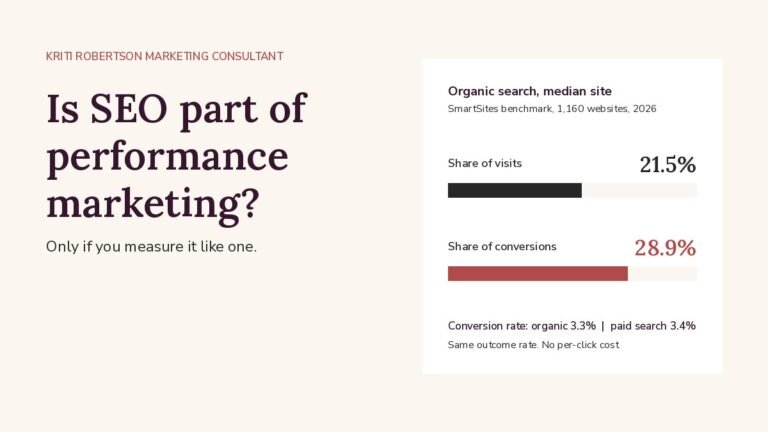
When organic search is measured on outcomes, the numbers hold up against paid. SmartSites published a benchmark study in September 2026 covering 1,160 client websites in GA4, with data running from October 2025 to September 2026. For the median site, organic search delivered 21.5% of visits but 28.9% of conversions. The median conversion rate was 3.3% for organic against 3.4% for paid search, a gap the authors describe as small. Organic was the top non-direct traffic source on 60% of the sites in the sample; paid search led on 16%. You can read the full breakdown in the SmartSites SEO Benchmarks 2026 study.
Read those figures the way a CFO would. A channel that converts at roughly the same rate as paid search, over-indexes on conversions relative to traffic, and carries no per-click cost is not a brand expense. It is a performance channel with a different cost structure: you pay upfront in labour and content instead of continuously in media. That is the whole case for SEO as performance marketing, and it only holds if you measure conversions, not sessions.
The same study also explains why so much SEO never gets there. The median click-through rate was 4.72% at position one, 1.90% at position two, and 0.22% at position ten, and 71% of a median site’s Google clicks came from top-three rankings. Page two is a rounding error. A retainer that moves you from position 30 to position 14 has produced no commercial outcome at all, however good the line chart looks.
Busy is not the same as working
I audited a Meta Ads account last year that looked healthy on the surface: consistent spend, decent engagement, retargeting audiences already built. Then I checked the campaign objectives. Every one was reach, profile visits, or link clicks, and the pixel only tracked page views. Meta had no idea what a valuable customer looked like for this business, so it was optimising for attention, not revenue. I would rather see a quiet ad account with three clean conversion events than a loud one with none.
SEO fails in exactly the same way, and it is harder to spot because nobody is watching a daily spend number. The account is busy. Blog posts go up every week. Rankings tick upward. The agency has a slide for everything. And the business has no idea whether any of it produced a customer, because organic search was never connected to a conversion event in the first place.
So when someone asks me “is SEO part of performance marketing,” I translate the question before answering it. What they are really asking is: can I hold this channel to the same standard as my ad spend? Yes. But only if you set it up to be held to that standard.
How I run SEO as a performance channel
These are the operating rules I apply on every organic SEO consultant engagement. They are not complicated. They are simply the rules paid media has lived by for a decade, applied to organic.
1. Clean the baseline before you trust it
I do not take the analytics dashboard at face value. On one ecommerce account the traffic numbers included a chunk of users from countries with no business reason to be visiting the site, almost certainly internal or team traffic inflating the real picture. The ad accounts were also billing in a different currency to the reporting currency, which would have skewed every cost-per-acquisition number if I had not converted it first. If you build a 12-month SEO plan on dirty numbers, you will measure the wrong thing for 12 months.
2. Define conversion events that mean money
Form submissions, booked calls, phone taps, purchases. Not scroll depth, not time on page, not newsletter sign-ups unless the newsletter demonstrably sells. Each event gets a value, even a rough one, so organic can be reported in revenue terms. This is the step most small business SEO services skip, and it is the step that decides whether SEO can ever be called performance marketing in your business.
3. Calculate a breakeven cost per acquisition and hold SEO to it
On a recent ecommerce project I set a hard rule for paid: pause any ad spend that cannot beat a calculated breakeven cost per acquisition, no exceptions, no “let’s give it another month.” Organic gets the same rule, just over a longer window. Total SEO investment over the quarter, divided by organic-attributed acquisitions, measured against the same breakeven number. If a content cluster cannot be expected to pay back inside a defined horizon, it does not get built.
4. Fix, then focus, then grow
Clients almost always want to talk about scaling first: more content, more pages, more keywords. I structure every roadmap in three deliberate phases instead. Fix in months one and two: tracking, technical health, and the basic conversion mechanics on the pages that already rank. Focus in months two to four: own the one search intent the data already proves is converting. Only then grow. Scaling a channel before the measurement works is how businesses end up with 200 blog posts and no pipeline.
5. Report on pipeline, not positions
My monthly SEO report is one page. Organic-attributed leads, organic-attributed revenue or pipeline value, cost per acquisition against breakeven, and the two or three changes I made as a result. Rankings go in an appendix for anyone who wants them. If a page one ranking did not produce an enquiry, it is a line item, not a win.
Why the agency model keeps SEO out of performance marketing
The structural problem is channel silos. At most agencies the SEO team and the paid team sit in different departments, report to different leads, and never see each other’s conversion data. The paid team knows exactly which search terms convert, because they have been buying them for months. The SEO team is guessing from a keyword tool. Nobody joins the two, so the business pays twice to learn the same thing.
That is the reason Kriti Robertson Marketing Consultant runs as a consultancy, not an agency. On a full-stack engagement I am the person running Meta ads, the person building the organic strategy, and the person checking the conversion tracking. There are no handoffs because there is nobody to hand off to. The paid data tells me which intents to build organic pages for, and the organic data tells me which paid terms I can stop buying once the page ranks. That loop is the single biggest lever I have found for turning SEO into a performance channel, and it is almost impossible to run across two agencies and a junior account manager.
It is also why I work as a full stack digital marketing consultant rather than a specialist. An independent SEO consultant who cannot see the ad account is working with half the data. A paid specialist who cannot touch the site is paying for clicks that organic should be winning.
When SEO should not be called performance marketing
I would be lying if I said every piece of SEO work passes the three-part test. Some of it does not, and it is better to say so upfront than to dress it up.
Technical foundations, site architecture, and brand-defining pages are investments with a long and uncertain payback. Top-of-funnel informational content often converts indirectly, through a reader who returns weeks later via direct or branded search, and no attribution model captures that cleanly. The time horizon is the honest difference. Paid search gives you a readable signal in two weeks. Organic typically needs a quarter to show a trend and two to three quarters to prove one, and the SmartSites click-through data above tells you why: until a page sits in the top three, the clicks barely register.
So my rule is to split the SEO budget into two lines. The performance line funds pages targeting commercial intent, measured on cost per acquisition like any other channel. The foundation line funds technical and informational work, measured on leading indicators with a fixed cap and a review date. Blending them into one retainer is how agencies hide the fact that neither line is being measured.
Local SEO is the clearest performance case of all
If you run a brick-and-mortar or service-area business, you have the easiest version of this argument. A Google Business Profile reports direction requests, website clicks, and phone calls directly. The SmartSites sample showed a median of 51 direction requests, 35 website clicks, and 11 phone calls per location per month. Those are outcomes, not impressions, and they attach to a profile you can change this afternoon.
It is why I built the Local SEO Sprint as a fixed-fee, 14-day intensive rather than a retainer. A local SEO consultant who cannot show you a before-and-after on calls and direction requests within a quarter is not doing performance work. The format forces the measurement. Four slots a month, a scored baseline on day one, a scored result on day 14, and nothing in between that cannot be tied to a number. For most operators, local SEO for small business is the fastest route from “we do some SEO” to “organic produced 23 calls last month.”
A five-line scorecard to settle the question in your own business
If you want to know whether SEO is part of performance marketing in your company, rather than in theory, score it against these five lines. Each needs a number, not a feeling.
First, organic-attributed conversions last quarter, as a count and as a share of all conversions. Second, organic conversion rate against paid conversion rate on the same key events. Third, total SEO cost last quarter divided by organic-attributed acquisitions, against your breakeven cost per acquisition. Fourth, the share of organic clicks that land on commercial-intent pages versus informational pages. Fifth, the number of paid search terms you have been able to pause because an organic page now ranks for them.
If you can fill in all five, SEO is already a performance channel for you, whatever your agency calls it. If you can fill in none, you are not running SEO. You are funding a reporting process. Either way you now know what to fix first, and the fix is measurement, not more content.
Where this sits in a full marketing system
SEO rarely fails alone. It fails alongside a paid account optimising for the wrong objective, an email list nobody segments, and a CRM that does not record where a lead came from. That is why I treat organic as one input into a single measured system rather than a standalone service, and why my work as a marketing strategy consultant always starts with a marketing audit of the whole funnel before any channel gets budget. The audit usually finds that the tracking, not the traffic, is the leak.
Once the measurement is in place, the stack compounds. Organic pages feed the retargeting audiences. The marketing automation layer scores and routes the organic leads so they are followed up in minutes rather than days. The paid account stops buying terms the site now owns. Each channel makes the others cheaper, which is the entire economic argument for a full-stack retainer over three separate agencies with three separate dashboards. If you want to see what that looks like on a real account, my post on how data-driven insights should shape a marketing strategy shows the before and after.
The short version
Is SEO part of performance marketing? It can be, and in a well-run business it should be. The 2026 benchmark data shows organic converting at the same rate as paid and over-delivering on conversions relative to traffic. The channel is not the problem. The measurement is. Set up conversion events that mean money, hold organic to a breakeven cost per acquisition, split the budget into a performance line and a foundation line, and report on pipeline rather than positions. Do that, and SEO earns its seat on the performance dashboard. Skip it, and you will keep paying for rankings and wondering where the customers went.
I audit the funnel in week one and tell you exactly where the leaks are, including whether your organic channel is producing pipeline or paperwork. If that is the conversation you need, the SEO consultant hub explains how I work and what the engagement looks like.