Kriti Robertson is an independent business marketing consultant based in Hong Kong. She works with a small, capped roster of business owners who are tired of agencies that sell tactics before they have a strategy. Her work covers marketing strategy, organic SEO and a 14 day Local SEO Sprint for businesses that need customers now.
Marketing Strategy vs Marketing Plan: Which One Is Your Business Actually Missing?
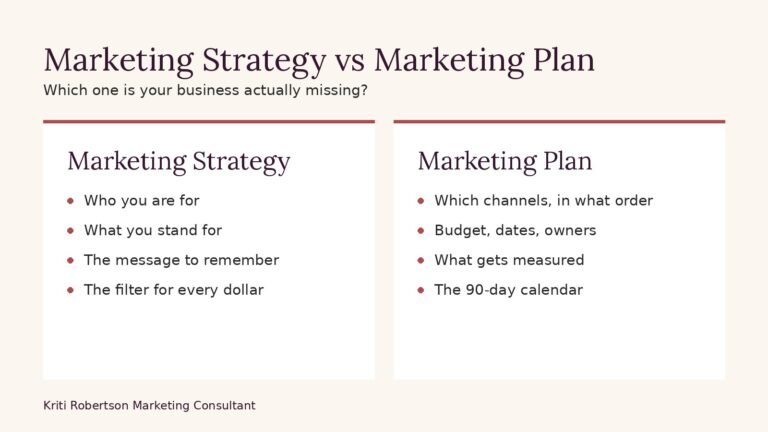
Most business owners who ask me about marketing strategy vs marketing plan are not really asking a definitions question. They are asking a diagnosis question. They have spent money, they have been busy, and something still is not working. So they want to know which of the two they are missing. In my experience the answer is nearly always the same one, and it is not the one they expect.
I am Kriti Robertson, and I run Kriti Robertson Marketing Consultant, or KRMC for short. I have sat across the table from enough founders to know that the marketing strategy vs marketing plan confusion is not academic. It is expensive. So this post is the plain version: what each one is, why they get mixed up, which one comes first, and how to tell in five minutes which one your business does not have.
The short answer
A marketing strategy is the set of decisions that tell you where you are going and why. Who you are for. What you stand for that your competitors do not. What message you want people to remember. Which problem you solve and for whom. It is the thinking.
A marketing plan is the schedule of activities that get you there. Which channels, what budget, what content, on what dates, measured by which numbers. It is the doing.
Strategy answers “why this and not that”. The plan answers “what, when, how much and who”. One is a filter, the other is a calendar. If you only remember one line from this post, remember that a plan without a strategy is a to-do list, and a strategy without a plan is a wish.
Why the two get confused
Because most of what gets sold as strategy is actually a plan. I have read a lot of agency proposals over the years. The typical one has a slide titled “Strategy” and underneath it says: four blog posts a month, two Meta campaigns, weekly LinkedIn posts, one newsletter. That is not a strategy. That is a list of things the agency knows how to sell. The client signs it because it looks like work is going to happen, and work does happen. It just happens in no particular direction.
The other reason is that a plan feels productive and a strategy feels like delay. When you are paying a retainer, you want to see things go live. Nobody gets excited about a document that says who your customer is. But without it, every campaign is a guess with a budget attached.
The data backs this up. CoSchedule surveyed more than 500 marketers for its Trend Report on Marketing Strategy and found that marketers who document their strategy were 414% more likely to report success than those who do not. In the same survey only 17% said they document their entire strategy. That gap between what works and what people actually do is the whole reason this post exists.
What a marketing strategy actually contains
If there is one marketing hill I am willing to die on, it is that strategy comes before execution. Not because strategy is exciting. It is not. But without it every marketing activity becomes a guess.
I have seen too many businesses launch a website, start posting, hire a Meta Ads agency, hire an SEO agency, spend thousands on Google Ads, and then six months later ask “why isn’t this working?” When I ask what success looks like, or who they are trying to reach, they often do not have an answer. The activity was real. The direction was missing.
My version of strategy is not a 100-page document. It is a North Star: one place that defines your target audience, your positioning, your messaging, your brand voice, your USPs, your competitors, and a 12-month roadmap. That document becomes the filter for every dollar you spend. When someone pitches you a TikTok campaign, you hold it up against the North Star and the answer is obvious in about thirty seconds.
Concretely, a strategy I would sign my name to answers these questions with evidence, not opinion:
Who is the customer, specifically, and what do they search for, worry about, and compare you against. What is the one thing you do that the competitor set does not, and can you prove it. Which search intent or channel is already converting, according to your own data, so we know where the first dollar should go. What does the funnel look like today, where are the leaks, and what is the breakeven cost per acquisition below which any ad spend gets paused. And what does “working” mean in numbers: pipeline, revenue, cost per lead, not clicks and impressions.
That last one matters. If your previous agency reported on reach and engagement, you never had a strategy. You had a plan with a vanity dashboard bolted on. This is the difference between hiring a marketing strategy consultant and hiring someone to keep your channels busy.
What a marketing plan actually contains
Once the strategy exists, the plan almost writes itself, which is the best evidence you have done the strategy properly. The plan is the operating document. It says which channels, in what order, with what budget, producing what, by when, measured how, and reviewed on what cadence.
A good plan is boring and specific. Meta ads go live in week three, not “Q1”. The budget is a number, not “test and scale”. The content calendar names the keyword each blog post targets and the page it links to. The review is a fixed Tuesday, not “we’ll check in”. If you want to see how I think about the review cadence, I wrote about how often to review and adjust your marketing strategy separately, because it deserves its own post.
Here is a rule I apply to every plan I build: it has to be sequenced. On a recent ecommerce project the client wanted to talk about scaling first. More spend, more content, more channels. I structured the roadmap in three deliberate phases instead. Fix in months one and two: tracking, catalogue, basic conversion mechanics. Focus in months two to four: own the one search intent the data already proved was converting. Only then, Grow. I also set a hard rule alongside it: pause any ad spend that cannot beat the calculated breakeven cost per acquisition. No exceptions, no “let’s give it one more week”. Scaling a broken funnel just gets you a bigger broken funnel, faster.
That sequence is a plan. The reason the sequence is Fix, Focus, Grow and not Grow, Grow, Grow is strategy.
Marketing strategy vs marketing plan: which comes first
Strategy. Always. And yet I will tell you about the one time I put it aside, because it is the exception that explains the rule.
I was ready to propose a full marketing strategy to a prospect. Once I actually spoke to them, I realised they were a small business owner who needed urgent fixes, not market research. They did not even have a website. Their Google Business Profile had the wrong category and photos from years ago. A 40-page strategy would have sat in a drawer while their phone stayed quiet.
So I went against my usual method and put strategy aside for straight implementation, because sometimes you do what the budget allows and what the business can absorb. That meeting is why I introduced the Local SEO Sprint: a fixed-fee, 14-day Google Business Profile intensive for brick-and-mortar businesses who are not ready for a strategy document yet. If that sounds like you, a local SEO consultant who fixes the profile in two weeks will move your numbers faster than a strategy deck will.
Good consultants do not force every client through the same process. You start where the business is, not where your framework begins. Sometimes implementation is the strategy. But notice what happened even in that case: I still made a strategic decision, which was that the single biggest constraint to growth was findability, and the plan was two weeks of fixing exactly that. The strategy was small. It was not absent.
How to tell which one you are missing
Here is the five-minute test I run, in my head, on every first conversation.
Ask yourself who your best customer is and write one sentence. If the sentence includes the words “anyone who” or “small to medium businesses”, you are missing a strategy. Ask what you would say no to. If you cannot name a channel, an audience or a type of work you would turn down, you are missing a strategy. Ask what your breakeven cost per acquisition is. If you do not know, you are missing a strategy, because nobody can build a sensible plan without that number.
Now the other side. If you can answer all three but you have not published anything in six weeks, your ads have been “about to launch” since spring, and your last marketing decision was made in a WhatsApp thread, you are missing a plan. The thinking is there. The machine is not.
And if you are honest and the answer is both, that is normal. It is the most common situation I walk into. It is also why I stopped selling strategy-only sessions. When I started KRMC I offered a clarity session: I would help clients think through their marketing and they would do the implementation themselves. A few client conversations changed my mind. Business owners are too busy running their businesses to think about their own marketing, let alone execute it. They did not want guidance. They wanted someone they could trust and hand the whole thing over to. So I rebuilt KRMC around done-for-you strategy plus implementation.
The vague-word trap
One more thing that sits between strategy and plan and quietly breaks both. A client once told me they wanted to be more aggressive with their marketing. Instead of nodding, I asked: what does aggressive mean to you? More spend, faster timeline, or bigger targets? Those are three different conversations, with three different plans and three different risks. They picked one, and we planned for that one.
Half of client frustration comes from consultants hearing a vague word and confidently building the wrong thing. “Aggressive”, “premium”, “viral”, “more content”. Each one needs unpacking before it goes anywhere near a plan. The strategy is where you unpack it. The plan is where the unpacked version becomes a budget and a date.
Where this fits with business strategy
A quick clarification, because it comes up. Marketing strategy sits underneath business strategy, not beside it. Business strategy decides which markets you are in and how you make money. Marketing strategy decides how you win attention and demand inside that. The plan sits underneath both. I have written about the difference between business strategy and marketing strategy if you want the longer version. For today, the point is that all three are different documents, and the one most small businesses skip is the middle one.
It is also why I am cautious about the channel-first way many businesses buy help. Hiring an organic SEO consultant, a paid media freelancer and a marketing automation specialist from three different places, and hoping the channels agree with each other, is how you end up with three plans and no strategy. Someone has to hold the whole picture. That is the job of a business marketing consultant who works across the full stack, and it is the reason I cap the retainer at three clients. Two people can do a lot. Not everything, for everyone.
What to do this week
If you have read this far and recognised your business in the “missing a strategy” column, do not commission a 100-page document. Write the North Star. One page. Audience, positioning, message, USPs, the two or three competitors you actually lose to, and what “working” means in numbers. It will take an afternoon if you are honest and a week if you are not.
If you recognised yourself in the “missing a plan” column, take the strategy you have and turn it into 90 days of dated, budgeted, measurable actions, sequenced Fix, Focus, Grow. Then put the review in the diary before the first action goes live.
And if you would rather hand the whole thing to someone who will build both and then run them, that is what a growth strategy consulting engagement with me looks like. I will audit your funnel in week one and tell you exactly where the leaks are. Then we fix them, in order.
Marketing is not about doing more. It is about doing the right things in the right order. The strategy tells you which things. The plan tells you the order.