Kriti Robertson is an independent business marketing consultant based in Hong Kong. She works with a small, capped roster of business owners who are tired of agencies that sell tactics before they have a strategy. Her work covers marketing strategy, organic SEO and a 14 day Local SEO Sprint for businesses that need customers now.
Fractional CMO vs Marketing Consultant: 5 Differences That Decide Who You Hire
Fractional CMO vs marketing consultant: the short answer
The fractional CMO vs marketing consultant question usually lands in my inbox as a pricing question. It is not one. It is a question about who owns the outcome. A marketing consultant is paid for an answer. A fractional CMO is paid for a result, and stays long enough to be held to it.
I should declare my bias. I run Kriti Robertson Marketing Consultant, so the word consultant is in my business name. In practice, most of the work I do at KRMC looks fractional. I have sold both models, and I stopped selling one of them. I will explain why further down.
Here is my verdict up front. If you have one clearly defined problem and a team that can execute, hire a consultant. If you have several channels, no senior marketer and a founder who has become the marketing department by accident, hire fractional.
What each title actually means
The two titles get used interchangeably on LinkedIn, which is why founders end up comparing quotes that are not comparable.
A marketing consultant is brought in for a scoped problem over a fixed period. The output is a deliverable: an audit, a positioning document, a channel plan, a tracking fix. The labels vary. You will see strategic marketing consultant, freelance marketing consultant and inbound marketing consultant, and they mostly describe a specialism, not a different way of working. When the deliverable is handed over, the engagement ends and the implementation is yours.
A fractional CMO sits inside your leadership team for a fraction of the week, on an ongoing basis. They set the priorities, own the budget, manage the vendors and report to you on pipeline and revenue. If you want the longer definitions, I have covered the part time CMO and the outsourced CMO models separately.
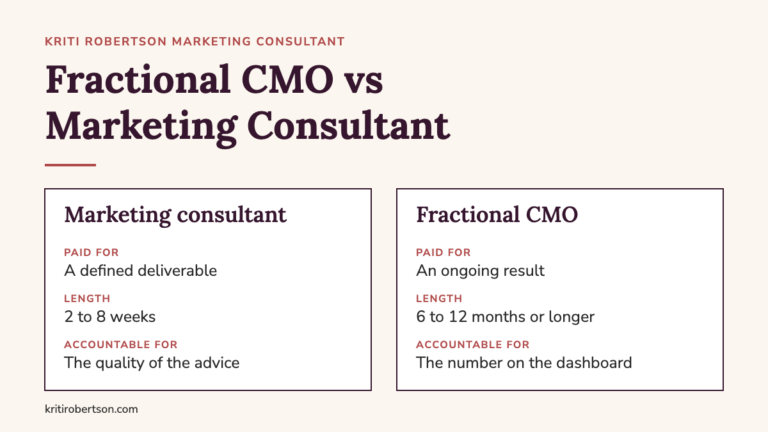
| Marketing consultant | Fractional CMO | |
|---|---|---|
| Paid for | A defined deliverable | An ongoing result |
| Typical length | 2 to 8 weeks | 6 to 12 months, often longer |
| Scope | One problem or one channel | The whole marketing system |
| Who implements | Your team | They direct it, and often do it |
| Accountable for | The quality of the advice | The number on the dashboard |
The 5 differences that decide the hire
1. Ownership: advice versus accountability
A consultant can be right and your revenue can still be flat. Their job was the recommendation. A fractional CMO does not get that exit. If leads are down in month four, it is their problem to diagnose and fix. This is the difference everything else follows from, so ask every candidate one question: what are you accountable for in six months?
2. Time horizon: project versus tenure
Consulting projects are short by design. Two to eight weeks is normal. Fractional work is measured in quarters, because SEO takes three to six months to move and a Meta ads account needs several weeks of clean conversion data before the numbers mean anything. If your problem needs compounding, a four-week project will not solve it.
3. Scope: one problem versus the whole system
You hire a consultant for the problem you think you have. That is fine when your diagnosis is correct. Often it is not. One client came to me for marketing help, and once I looked closer the real issue was operations: broken links through the customer journey, too many manual processes and systems that did not talk to each other. A narrow brief would have had me running campaigns into that. I diagnose businesses, not just channels, and that only works when the scope allows it.
4. Implementation: who does the work on Monday
This is where most consulting projects quietly fail. The strategy is sound, the PDF is well designed, and nothing changes because nobody has the hours to build it. A fractional CMO either executes or directs the people who do. At KRMC I work as a full stack digital marketing consultant, which means the person who wrote the strategy is the same person checking the conversion tracking.
5. Price: what you are actually paying for
Consultants usually quote a project fee or an hourly rate. Fractional CMOs usually quote a monthly retainer. Comparing the two on headline price is a mistake, because one buys a document and the other buys a function. I have broken down what a marketing consultant costs in a separate post if you want the numbers.
What the data says about fractional CMO vs marketing consultant demand
I checked two sources before writing this, because the fractional CMO vs marketing consultant debate is usually argued on opinion.
The first is search data. In the SE Ranking US database for October 2026, “marketing consultant” gets around 9,900 searches a month and “fractional CMO” gets around 2,400. Four times as many people are looking for a consultant. But advertisers pay an average of $8.79 per click for the fractional term against $4.41 for the consultant term. My reading is simple. Fewer people search for a fractional CMO, and each one is worth roughly double to the firms bidding, because that buyer is signing a longer and larger engagement.
The second is the 2026 State of Fractional Work report from Go Fractional, built on 18,080 member profiles, 8,802 job postings and 213 survey responses. It puts the average fractional CMO rate at $175 an hour and found that most fractional professionals work with two to three clients at a time. That second number matters more than the rate. Someone carrying eight clients is not a fractional CMO, whatever their profile says. It is the reason I cap my own Full-Stack Strategic Retainer at three clients.
Why I stopped selling strategy-only sessions
When I started KRMC I offered a clarity session. I would help a client clarify their marketing, give guidance on strategy, and they would do the implementation themselves. Classic consulting.
A few client conversations changed my mind. The pattern was always the same. Business owners are too busy running their businesses to think about their own marketing, let alone execute it. They did not want guidance. They wanted to find someone they could trust and hand the whole thing over.
So I rebuilt KRMC around done-for-you strategy plus implementation. I am still a business marketing consultant by title. The operating model is fractional. A strategy nobody has time to build is not a service. It is homework.
When a marketing consultant is the right hire
I am not arguing against consultants. There are situations where a fixed-scope project is the better use of money.
- You have one defined problem. Your Google Business Profile is not showing up, or your tracking is broken. Hire a specialist, such as a local SEO consultant or a marketing automation specialist, fix it and move on.
- You already have a team that executes. An in-house marketer who needs senior direction can take a plan from a marketing strategy consultant and run with it.
- Your budget does not stretch to a retainer. Sometimes you do what the budget allows. This is exactly why I built the Local SEO Sprint: a fixed-fee, 14-day intensive for owners who need local SEO for small business sorted, not a 40-page strategy.
If you are looking for a small business marketing consultant, start here. A scoped project is a low-risk way to test whether someone is any good before you commit to more.
When a fractional CMO is the right hire
- You are managing three or more vendors. A Meta ads agency, an SEO agency and a freelancer for email, each sending a monthly PDF, none of them talking to each other. That is the broken agency model: junior account managers, channel silos and report theatre. Someone senior has to own the whole picture.
- You are the marketing department. If every campaign waits on your approval and your judgement, you do not need more advice. You need someone to take the decision off your desk.
- The work needs sequencing. On a recent ecommerce project I structured the roadmap in three phases. Fix in months one and two: tracking, catalogue and basic conversion mechanics. Focus in months two to four: own the one search intent the data proved was converting. Only then Grow. Nobody can run a three-phase plan in a four-week project.
- You want growth across channels. Proper growth strategy consulting connects paid, organic and automation. An organic SEO consultant can lift one channel. Only an owner of the whole system can decide where the next dollar goes.
4 questions to ask before you sign either
- What are you accountable for, and by when? A deliverable and a date means consultant. A metric and a quarter means fractional.
- Who does the implementation? If the answer is “your team” and you do not have one, stop there.
- How many clients do you carry? Two to three is the norm for real fractional work. Ten means you are buying a small agency with one name on the door.
- What will you report on? Pipeline, conversion rate and cost per acquisition are acceptable answers. Impressions and clicks are not.
Frequently asked questions
Is a fractional CMO just an expensive marketing consultant?
No. The rate is higher because the responsibility is different. A consultant is responsible for the advice. A fractional CMO is responsible for what happens after it.
Can a marketing consultant become my fractional CMO?
Yes, and it is often the safest route. Start with a scoped audit or sprint. If the thinking is good and the work lands, extend it into an ongoing role.
Which is cheaper?
A consultant, on the invoice. Whether it is cheaper overall depends on whether the plan gets implemented. A strategy that sits in a folder costs more than a retainer that moves revenue.
My verdict
The fractional CMO vs marketing consultant decision comes down to one thing: do you need an answer, or do you need an owner. If your team can execute and you are missing direction on one problem, buy the answer. If you are an established founder tired of stitching together fragmented retainers, you need an owner.
The title matters less than the terms. Judge the person by what they will be accountable for, not by what they call themselves.
If you are not sure which side you are on, I will audit your funnel in week one and tell you exactly where the leaks are. You can see how that has worked for other businesses in my Kriti Robertson Marketing Consultant case studies, or look at my services and decide from there.