Kriti Robertson is an independent business marketing consultant based in Hong Kong. She works with a small, capped roster of business owners who are tired of agencies that sell tactics before they have a strategy. Her work covers marketing strategy, organic SEO and a 14 day Local SEO Sprint for businesses that need customers now.
How to Tell If SEO Is Working: 7 Signals That Matter, and 4 That Mislead
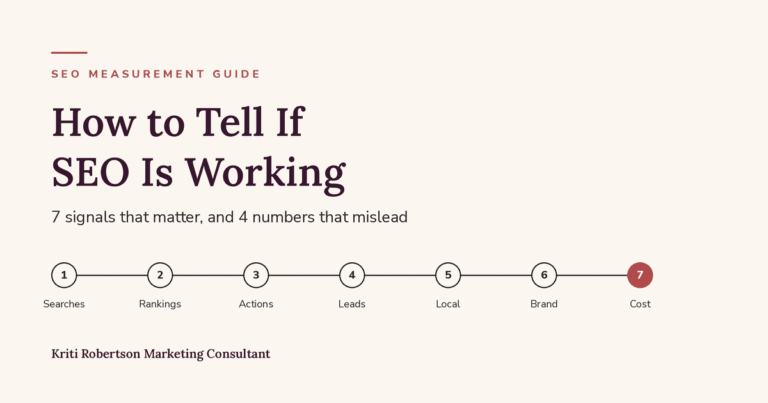
Most founders cannot answer a simple question about a channel they pay for every month: is it working? If you want to know how to tell if SEO is working, ignore the traffic graph and start with the only test that counts. Is organic search producing enquiries, booked calls and revenue that would not exist without it? Everything else is a signal on the way to that answer, or a distraction from it.
I am Kriti Robertson, and through Kriti Robertson Marketing Consultant (KRMC) I run SEO as part of a full marketing system, never as a silo. Below are the seven signals I check, the four numbers I ignore, and the timeline I hold every campaign to.
Why it is harder to tell if SEO is working in 2026
The old shortcut was clicks. Rank first, get the click, count the visit. That shortcut is broken.
Ahrefs compared 300,000 keywords and found that an AI Overview now correlates with a 58% lower clickthrough rate for the top-ranking page. That is position one, losing more than half its clicks, without dropping a single place. Separately, SparkToro’s analysis of Similarweb data, reported by TechWyse, found that 68% of US Google searches between January and April 2026 ended without a click to any website, up from roughly 60% in 2024.
Read those two numbers together. You can rank better than last year and still receive less traffic. So a falling traffic line no longer proves SEO is failing, and a rising one does not prove it is working. Traffic was always a weak proxy. Now it is an unreliable one. The measurement has to move closer to the money.
Set the clock first: what should happen, and when
You cannot judge a campaign without a timeline. Google’s own guidance says SEO typically takes four months to a year from the first changes to the first real benefits. That is the honest range. Anyone promising page one in 30 days is selling you something else.
Inside that range, I split signals into two groups.
Leading signals show up in weeks 4 to 12. Pages get indexed. You start appearing for the searches you targeted. Positions move from page three to page two. None of this is a result. It is evidence that the work is pointed in the right direction.
Lagging signals show up from month 4 onward. Enquiries from organic search. Calls from your Google Business Profile. Leads that turn into customers. These are the results. If the leading signals never arrive, the lagging ones will not either, and you should know that by month three, not month twelve.
Clean the baseline before you measure anything
Before I build a strategy, I build a baseline, and I do not take the analytics dashboard at face value. On one ecommerce account, the traffic numbers included a chunk of users from countries with no business reason to visit the site. It was almost certainly internal and team traffic, inflating the real picture. If I had measured SEO progress against that number, every month would have looked worse than it was, or better, depending on how busy the team had been.
You cannot trust a baseline you have not cleaned. Exclude internal traffic. Separate brand searches from non-brand searches. Confirm that your conversion events fire once, on the right action. Write down the starting numbers and the date. It takes a day, and it is the difference between knowing and guessing for the next twelve months.
Signal 1: You appear for the right searches
Open Google Search Console and filter out your brand name. Look at the queries left. Are they the searches a buyer would type, or random informational phrases that will never produce a customer? Early on, I want to see the business showing up for the specific terms in the keyword map. Showing up for more searches means nothing. Showing up for the right ones is the first real sign of life.
Signal 2: The pages that sell are climbing
Not all rankings are equal. A blog post reaching position four for a curiosity query is pleasant. A service page moving from position 18 to position 7 for a buying-intent term is worth money. Track 10 to 20 commercial keywords, each mapped to one page, and watch their average position month on month. If the only pages climbing are the ones that cannot convert, the campaign is busy, not working.
Signal 3: Organic visitors take action
In Google Analytics 4, mark the actions that matter as key events: form submissions, booked calls, phone taps, purchases. Then filter by the organic search channel. This is the number I look at first every month. Fifty organic visitors who produce five enquiries beat five thousand who produce none. If organic conversions are flat while traffic climbs, you are attracting the wrong people, and more content will not fix that.
Signal 4: The leads are the right leads
An enquiry is not a customer. Ask every new lead how they found you, record the source in your CRM, and review it monthly. How many organic leads were a fit? How many became proposals? How many paid? This takes ten minutes and tells you more than any ranking report. It is also the step most agencies skip, because lead quality sits in your sales pipeline, outside the PDF they send you.
Signal 5: Local actions are rising
If you serve a local area, your Google Business Profile is the scoreboard. Calls, direction requests, website taps and bookings are all reported inside the profile, month by month. Those are real people doing real things.
Do not assume reviews mean you are winning here. I scored one client’s profile and the reviews came out at 4 out of 5: high volume, strong ratings. Then I scored the rest. Wrong category, no posts, no products, photos two to six years old, no keyword alignment. Total: 26 out of 60. Reviews build trust once someone is already looking at you. They do very little to help a stranger find you in the first place. This gap is the reason the Local SEO Sprint exists, and it is what I fix in 14 days as a local SEO consultant. For most brick-and-mortar operators, local SEO for small business starts and ends with that profile.
Signal 6: More people search for you by name
When 68% of searches end without a click, visibility still does a job. Someone reads your answer in the results, remembers the name, and searches for you directly next week. So watch branded search volume in Search Console, and check whether AI answers cite you for the questions your buyers ask. Rising brand searches alongside steady non-brand visibility is a healthy pattern, even when total clicks are flat. I treat this as a supporting signal. It never replaces Signal 3.
Signal 7: Organic costs less per customer over time
This is the bottom-line test. Take what you spend on SEO in a quarter and divide it by the customers organic search produced. Compare that with the same figure for Meta ads or Google Ads. In the first quarter, SEO will lose that comparison. That is normal. By the third or fourth quarter, the organic cost per customer should be falling, because the pages you built keep working without a daily budget. If it is not falling after a year, something is wrong with the strategy, the execution, or the offer.
Four numbers that mislead you
Total traffic. I covered why above. It can rise with the wrong visitors and fall while revenue grows.
Number of keywords ranked. “You now rank for 1,200 keywords” sounds impressive. Ask how many are on page one, and how many a buyer would ever type. The honest answer is usually a much smaller number.
Authority scores. Domain Authority and Domain Rating are third-party estimates. Google does not use them, and your bank does not accept them.
Impressions and clicks on their own. They are diagnostics. Useful to me while I work, meaningless as a headline result. I audited an ad account once that looked healthy on the surface, with consistent spend and decent engagement, yet nothing in it was set up to track a sale. The same thing happens in SEO reporting. Busy is not the same as working.
Almost every business owner who comes to me has already spent thousands with agencies that reported on numbers like these. By the time we speak, they are burnt out and find it hard to trust anyone. I understand why. A 20-page report of rising lines, with no mention of leads, is theatre.
The 15-minute monthly check
You do not need a dashboard subscription to know how to tell if SEO is working. You need four questions, asked on the same day each month.
Step 1. In Search Console, filter out brand queries. Are the target terms gaining position compared with last month?
Step 2. In Google Analytics 4, filter to organic search. How many key events did it produce, and is that up or down against the baseline?
Step 3. In your CRM or enquiry log, count the organic leads. How many were a fit, and how many became customers?
Step 4. In your Google Business Profile, note calls, direction requests and bookings.
Write the four answers in one sheet. After three months you will have a trend, and a trend is what tells you the truth. If you would rather not run this yourself, it is part of what you should expect from any organic SEO consultant or provider of small business SEO services: the answers, in plain language, every month.
When to worry, and what to ask
Month 3 with no leading signals. No new pages indexed, no movement on target terms, no technical fixes shipped. Ask what was done, specifically, and ask to see it.
Month 6 with movement but no enquiries. The campaign is probably chasing the wrong keywords, or sending the right visitors to pages that do not convert. That is a strategy problem, and it is why I will not run SEO separately from the wider plan. A marketing strategy consultant should be able to tell you which of the two it is within a week.
Any month where you cannot get a straight answer. If the person reporting to you is not the person doing the work, and neither can say what organic search produced in leads, you have your answer about the provider, if not about SEO. This is the case for working with an independent SEO consultant: the person who wrote the strategy is the person checking the tracking.
How to tell if SEO is working: the short version
Clean the baseline. Expect leading signals by month three and results from month four to twelve. Judge the campaign on organic enquiries, lead quality, local actions and cost per customer. Ignore total traffic, keyword counts and authority scores. If you can only track one thing, track enquiries from organic search against the baseline, monthly.
That is how to tell if SEO is working, and it fits on one page. Good SEO should be easy to prove. If it is not, either the tracking is broken or the work is.
Inside the Full-Stack Strategic Retainer, I run SEO, Meta ads and AI automation as one system for a maximum of three clients, and I report on pipeline, not activity. In week one I audit the funnel and tell you exactly where the leaks are. If you want a business marketing consultant who will show you what your SEO has produced, in numbers you can check yourself, apply to work together.