Kriti Robertson is an independent business marketing consultant based in Hong Kong. She works with a small, capped roster of business owners who are tired of agencies that sell tactics before they have a strategy. Her work covers marketing strategy, organic SEO and a 14 day Local SEO Sprint for businesses that need customers now.
How to Create a Winning B2B SEO Campaign: 7 Steps That Build Pipeline, Not Traffic
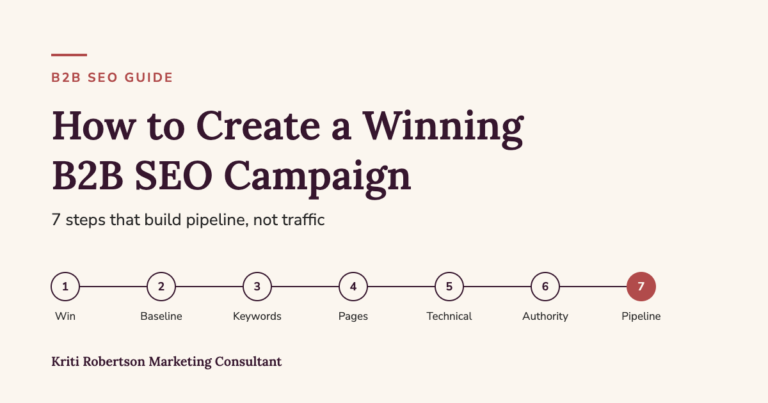
Most B2B SEO fails for a boring reason. The campaign was built to win traffic, and the business needed pipeline. If you want to know how to create a winning B2B SEO campaign, start there: the goal is qualified conversations with the right buying committee, measured in opportunities and revenue. Rankings are a means. Sessions are a means. Neither pays an invoice.
I am Kriti Robertson, and through Kriti Robertson Marketing Consultant (KRMC) I build SEO as part of a full marketing system, never as a silo. This is the seven-step process I use, in the order I use it. The order matters more than any single tactic.
Why B2B SEO plays by different rules
A consumer buys running shoes in one evening. A B2B deal takes months and a room full of people. Research from 6sense, reported by Demand Gen Report, found that B2B buyers are nearly 70% of the way through their purchasing process before they speak to a seller, that buyers initiate first contact 80% of the time, and that 81% already have a preferred vendor when they do. The same research puts the average buying cycle at 11.3 months and the average buying group at 11 people.
Read those numbers again as an SEO brief. Most of the decision is made in private, through search, long before your sales team hears a name. Eleven people are each typing different questions. The finance lead searches cost. The operations lead searches integration. The end user searches “how to”. If you are not the answer during those quiet months, you are not on the shortlist when the enquiry form finally gets filled in. That is the job of a B2B SEO campaign: be present and credible across the whole private research phase.
Step 1: Define the win before you touch a keyword
If there is one marketing hill I am willing to die on, it is that strategy comes before execution. Without it, every activity is a guess. So the first document in a campaign is one page, not a keyword list. It states who the ideal customer is, what a qualified lead looks like, what a closed deal is worth, and how many opportunities per quarter SEO must contribute for the investment to make sense.
Work backwards. Say a deal is worth $40,000 and you close one in five qualified opportunities. Each opportunity is then worth $8,000 to you. Now you know what you can afford to spend to create one, and you have a number to hold the campaign to. This is the work a marketing strategy consultant should do before anyone opens an SEO tool. Skip it and you get the classic agency outcome: a PDF report full of green arrows and a sales team with nobody to call.
Step 2: Clean the baseline before you set a target
Before I build a strategy, I build a baseline, and I do not take the analytics dashboard at face value. On one account I audited, the traffic numbers included a chunk of users from countries with no business reason to visit the site. It was almost certainly internal and team traffic inflating the picture. Build a 12-month plan on dirty numbers and every target in it is wrong from day one.
For B2B the baseline needs three things. First, conversion events that mean something: demo requests, quote requests, contact forms, pricing page visits. Second, internal traffic filtered out. Third, a line from the form fill into your CRM, so that in six months you can say which page produced which opportunity. Clients almost always want to talk about scaling first. I structure the roadmap as Fix, Focus, Grow, and tracking sits in Fix. You cannot grow what you cannot measure.
Step 3: Map keywords to the buying committee, not to volume
B2B keyword research punishes people who sort by search volume. The terms that produce pipeline are often small. A phrase with 80 searches a month, typed by a procurement lead comparing two vendors, is worth more than a 10,000-search definition term read by students.
I sort keywords into three groups. Problem terms, where the buyer is naming the pain. Solution terms, where they are comparing approaches, including “vs”, “alternative” and “cost” searches. And vendor terms, where they are checking you out specifically. Then I map each group to a role in the committee. If your content only speaks to the end user, the finance lead finds your competitor’s pricing explainer and never sees yours.
One more rule: write in the buyer’s language. I had a client who led all of their marketing with an insider term their first-time customers had never heard. Businesses market in the language of people who already buy from them. Search does not work that way. Use the words the buyer types, then introduce your own terminology once they understand the benefit.
Step 4: Build the pages that close before the pages that attract
Agencies love to start with a blog calendar, because blog posts are easy to count in a monthly report. I start at the bottom of the funnel. Service pages, industry pages, comparison pages, a page explaining pricing or how an engagement works, and case studies with real numbers. These are the pages a buyer reads in the last 30% of the journey, and they are the pages that turn a visit into a conversation.
Only then do I build the informational content that feeds them. Every article gets one job: answer a real question from the committee, then pass the reader to a commercial page with an internal link. An article with no next step is a dead end. It might rank. It will not sell.
Step 5: Fix the technical foundations once, properly
Technical SEO in B2B is rarely glamorous and never optional. The site has to load quickly, work on a phone, and be crawlable. Each page needs one clear topic, a title that matches intent, and schema where it helps. Duplicate service pages competing for the same term should be merged. None of this wins the campaign alone. All of it can lose the campaign, because the best content in your category does nothing on a page Google struggles to read.
This is where an organic SEO consultant earns the fee: knowing which of the 200 issues in an audit tool affect revenue and which are noise. I fix the handful that matter in the first month and move on. If you sell across borders, add country and language targeting to that list, which is specialist work for an international SEO consultant. And if part of your B2B revenue is regional, such as a supplier serving one city or trade area, your Google Business Profile matters as much as your website. That is local SEO consultant territory, and it is why I run it as a separate, fixed-fee 14-day Local SEO Sprint.
Step 6: Earn authority in the places your buyers already trust
Links still matter, but the B2B version of authority is narrower than most link-building packages suggest. Fifty links from irrelevant directories do less than three from the trade publication your buyers read, the association they belong to, and the partner whose software they already use.
I look for the whitespace before I look at what everyone else is doing. In one competitor review I ran, every smaller brand in the category was copying the market leader’s positioning, and nobody was competing on proof or credibility. The gap was sitting in the open. The same thinking applies to authority. Publish original data from your own work. Put a named expert on every article. Get your case studies quoted. Buyers favour sources with evidence behind them, and so do the AI tools that now summarise search results for them. A B2B SEO consultant who only talks about link volume is selling you an old playbook.
Step 7: Report on pipeline, and connect SEO to everything else
Here is the reporting standard I hold myself to. Every month: qualified leads from organic search, opportunities created, pipeline value, and revenue closed. Rankings and traffic appear only as diagnostics underneath. I once audited an ad account that looked healthy on the surface, with consistent spend and decent engagement, and it was optimised for attention, not revenue. Busy is not the same as working. SEO reports hide the same problem behind impressions.
SEO also cannot carry a long sales cycle alone. Someone who reads your comparison page in March and buys in November needs to hear from you in between. That means email nurture, retargeting and lead scoring wired into the same system. It is the reason I work as a full stack digital marketing consultant and not a channel specialist. The search visit, the follow-up sequence a marketing automation specialist would build, and the paid retargeting all need one owner. In the agency model those sit with three teams and a junior account manager in the middle. Nothing gets lost in handoffs when there are no handoffs, which is the practical argument for hiring an independent SEO consultant over a rotating account team.
What a realistic B2B SEO timeline looks like
A B2B SEO campaign is a 6 to 12 month commitment, and anyone promising page one in 30 days is selling something else. My expectation for a site with no serious penalties or rebuild needed: months one and two are Fix, covering tracking, technical issues and the commercial pages. Months two to four are Focus, where you own the one or two search intents your data already shows are converting. From month four onwards you Grow, adding content clusters and authority.
Then add the sales cycle on top. With an average buying cycle of 11.3 months, revenue from a visit today may land next year. Plan the budget for that, or do not start. Stopping at month four is the most expensive way to do SEO, because you pay for the foundations and leave before the return.
The mistakes I see most often
Three patterns come up in almost every B2B account I review. Chasing volume over intent, which fills the top of the funnel with people who will never buy. Publishing without a conversion path, so good articles lead nowhere. And reporting on vanity metrics, which is how a business spends a year on SEO and cannot say what it produced.
Almost every founder who comes to me has already spent thousands with agencies or freelancers and is burnt out by exactly this. The fix is not more content. It is a campaign with a defined win, a clean baseline, and one person accountable for the result.
How to create a winning B2B SEO campaign: the short version
If you remember nothing else about how to create a winning B2B SEO campaign, remember the order. Define the win in pipeline terms. Clean the baseline. Map keywords to the buying committee. Build the pages that close. Fix the foundations. Earn authority where buyers already look. Report on revenue. Most campaigns that fail skipped the first two steps and started at the fourth.
This is the work I do inside the Full-Stack Strategic Retainer, where SEO, Meta ads and AI automation run as one system for a maximum of three clients at a time. If you would like a business marketing consultant to audit your funnel in week one and tell you exactly where the leaks are, that is where I start. You can see how this plays out in practice in my Kriti Robertson Marketing Consultant case studies. A winning campaign is not louder than the competition. It is simply there, with the right answer, every time the buyer goes looking.