Kriti Robertson is an independent business marketing consultant based in Hong Kong. She works with a small, capped roster of business owners who are tired of agencies that sell tactics before they have a strategy. Her work covers marketing strategy, organic SEO and a 14 day Local SEO Sprint for businesses that need customers now.
Is It Worth Hiring an SEO Company? What I Tell Founders Before They Sign Another Retainer
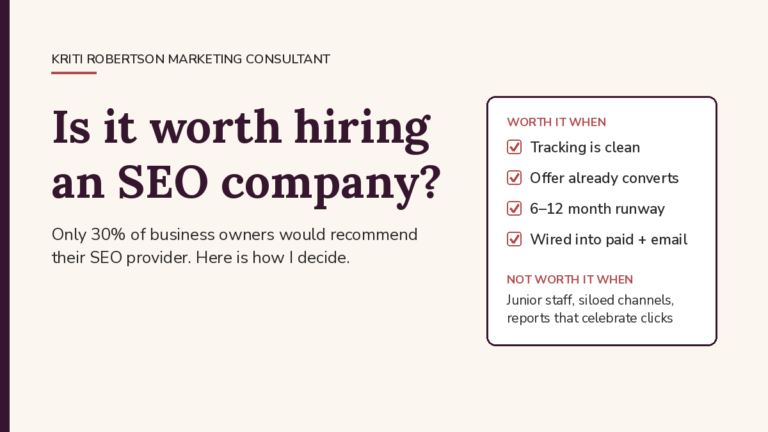
Is it worth hiring an SEO company? I get asked this most weeks, usually by a founder who has already paid one. The question underneath is rarely about SEO. It is about trust. They spent twelve months and a five-figure sum on a retainer, received a monthly PDF full of rankings and impressions, and cannot point to a single customer that came from it. So let me answer the question properly, with numbers, and with the candour I would want if I were the one signing the contract.
The short answer: SEO is worth it for most established businesses. Hiring an SEO company, in the way most of them are structured, often is not. Those are two different questions, and the agency model has spent years blurring them.
Is it worth hiring an SEO company? What the data says
Start with what clients themselves report. A Backlinko survey of 1,200 business owners, most of them small businesses, found that only 30 percent would recommend their current SEO provider. One in four said they were unsure what they were even paying for. Among clients who had already left a provider, 82 percent cited dissatisfaction with business results and 81 percent cited cost.
Read that again. The most common reason people stop paying for SEO is not that SEO stopped working. It is that nobody could show them it was working for the business, rather than for a dashboard.
The same survey found a pattern I see constantly: clients spending under 500 dollars a month were 75 percent more likely to be dissatisfied than those spending more. That is not an argument for spending more. It is evidence that very cheap SEO packages for small business buyers tend to deliver very little, because at that price the work is templated, outsourced, or both.
Now the pricing side. Ahrefs polled 439 SEO providers for its SEO pricing study. Agencies averaged 3,209 dollars a month on retainer. Consultancies averaged 3,250 dollars. Freelancers averaged about 1,349 dollars. Hourly, consultancies charged roughly 171 dollars against 99 dollars for agencies. Local SEO retainers averaged 1,557 dollars a month, less than half the worldwide average of 3,474 dollars.
So an agency and an independent consultant cost roughly the same per month. The difference is what the money buys. In an agency, your 3,200 dollars funds a slice of a strategist, a slice of a junior account manager, a slice of a content writer, and the overhead above all of them. With an independent SEO consultant, the person you pay is the person doing the work. Same price, very different output.
SEO is not the problem. The agency model is
My positioning as Kriti Robertson Marketing Consultant did not come from a branding exercise. It came from a client I still work with today. Before me, they hired a large agency with excellent reviews and high-profile logos in its case studies, and they received a substandard service. Junior staff ran the account. Channels sat in silos, so the SEO team did not know what the paid team was doing. Every month a report arrived that celebrated impressions and never mentioned revenue. Watching what that experience did to a good business is why KRMC is a consultancy and not an agency.
That client is not unusual. Almost every founder who comes to me has already spent thousands with agencies or freelancers. They arrive burnt out and slow to trust, even when what I am telling them makes obvious sense. The distrust is something I have to work through before strategy can even begin. The agency model created that, and the agency model keeps feeding it.
So when a founder asks me whether it is worth hiring an SEO company, I reframe it. Is it worth paying for SEO work that is tied to pipeline, done by a senior person, inside a strategy that connects it to your other channels? Yes, nearly always. Is it worth paying for rankings theatre delivered by a rotating cast of account managers? No, and the churn numbers above say so.
Four situations where it is not worth hiring an SEO company yet
I turn away SEO work more often than people expect. If you are asking whether it is worth hiring an SEO company and any of the following is true, my answer is not yet.
Your tracking cannot prove anything. If your website does not record enquiries, calls, or purchases as conversion events, no SEO company on earth can show you a return. They will show you traffic instead, because traffic is all they can see. I will not start an organic programme until a clean baseline exists. On one ecommerce account the analytics included a block of users from countries with no business reason to visit, almost certainly internal traffic, and the ad platform was billing in a different currency to the reporting currency. Build a twelve-month plan on dirty numbers and every decision inherits the error.
Your offer is not yet converting the visitors you already have. SEO multiplies what already works. If 300 people a month land on your service page and two enquire, ranking for more terms gets you four enquiries at double the cost. A marketing strategy consultant fixes the conversion problem first. Then SEO has something worth multiplying.
You are a local business with an unoptimised Google Business Profile. For a dentist, a clinic, a tailor, or a restaurant, the map pack matters more than page one of the organic results. I scored a client’s profile recently. Their reviews were excellent, high volume and strong ratings. Then I scored the rest: wrong primary category, no posts, no products, photos between two and six years old, zero keyword alignment. Twenty-six out of sixty. Reviews build trust once someone is already looking at you. They do nothing to help someone find you. A 3,000-dollar-a-month retainer for blog content is the wrong purchase when the profile that actually drives your calls is half empty.
You need results in 90 days. SEO does not work on that clock, and any company promising it is setting you up to churn. If the next quarter decides whether the business survives, spend on paid search and conversion work, and start SEO once the pressure is off.
When hiring SEO help is clearly worth it
Three conditions, and when all three are present I will say yes without hedging.
First, you have a product or service with proven demand, and you know which search intent already converts. On a recent ecommerce project the data showed one specific product search was carrying the revenue. The job was not to rank for 400 keywords. It was to own that one intent completely, then widen from there.
Second, your margins can absorb a six-to-twelve-month runway. Organic search compounds. The cost of each enquiry falls as the asset matures, which is the opposite of paid media, where cost per lead rises the moment you stop spending. If you can fund the runway, SEO becomes the cheapest acquisition channel you own. If you cannot, it becomes an expensive hobby.
Third, you have decided to treat SEO as part of a system rather than a silo. The best organic results I have delivered came from accounts where SEO, Meta ads, email and automation shared one strategy and one person accountable for all of it. A full stack digital marketing consultant can see that a blog post built for search is also the retargeting audience for the ads and the trigger for the nurture sequence. An SEO-only vendor cannot, because they are not paid to look.
What you should actually be paying for
Price is the wrong first question, but it is the one everyone asks, so here is how I think about it.
Most small business SEO services sold under 1,000 dollars a month are a checklist: a plugin configured, a few meta descriptions rewritten, two generic articles, a report. That is not worthless, but it is not strategy, and it will not move a competitive term. The Ahrefs data puts the most common retainer bracket at 501 to 1,000 dollars, which tells you how much of the market is buying exactly that.
At the 2,500 to 4,000 dollar level, which is where both agencies and consultancies cluster, you should expect senior involvement, a documented keyword-to-page map, technical fixes implemented rather than recommended, content written for a specific intent, and reporting in enquiries and revenue. If the proposal in front of you does not describe those things in plain language, the price is high for what it is, whatever the number.
For local operators, the picture is simpler and cheaper. Local SEO for small business is a different discipline from national organic search, and it is priced accordingly. A local SEO consultant who fixes the profile, the citations, the service pages and the review process in a fixed sprint will outperform a rolling retainer for most brick-and-mortar businesses. That is why I built my Local SEO Sprint as a fixed-fee fourteen-day intensive rather than a monthly fee. It came from a meeting with a small business owner who needed urgent fixes, not a forty-page strategy document. Sometimes you do what the budget allows, and you make the fix sharp instead of long.
Eight questions to ask before you sign
These are the questions I would want answered before paying anyone for SEO, including me.
Who, by name, does the work on my account, and what is their experience? If the answer is a team, ask who on the team has more than five years of hands-on SEO.
What conversion events will you report on, and will you set them up in week one?
Which pages are you targeting, for which keywords, and why those? A real plan has a keyword-to-page map. A sales deck has a list of impressive-sounding terms.
How does the SEO work connect to my paid, email and automation channels? If the answer is that those are separate departments, you have found a silo.
What happens in month one, month three and month six? Vague timelines hide absent plans.
Will technical fixes be implemented or just recommended in a document for my developer? I have watched clients lose months to recommendations nobody owned.
What would make you tell me to stop spending? A provider with no answer has never told a client to stop.
What does success look like in revenue, not rankings? If they cannot translate, they cannot be held accountable.
How I answer the question for my own clients
I run Kriti Robertson Marketing Consultant, KRMC, as a premium one-woman full-stack consultancy. I am a business marketing consultant first and an organic SEO consultant second, and I keep the order deliberately. Strategy decides whether SEO is the right spend. Only then do I build the programme.
When a founder is a fit for my Full-Stack Strategic Retainer, SEO sits alongside Meta ads and AI automation under a single plan, and I cap the retainer at three clients so each one gets a senior operator rather than a junior account manager. When a bootstrapped local operator needs plug-and-play fixes, the Local SEO Sprint does the job in fourteen days for a fixed fee. When someone wants the frameworks without the engagement, the Template Shop carries the SOPs and dashboards I use myself. I would rather send a business to the right offer than sell it the wrong one.
I will audit your funnel in week one and tell you exactly where the leaks are. If the leak is tracking, I say so and we fix it before a single SEO deliverable is produced. If the leak is operations, I flag it even though it is not what you hired me for. One client came to me for marketing, and the real problem was broken links through the customer journey and systems that did not talk to each other. Running campaigns on top of that would have generated demand the business could not handle. A marketing automation specialist and an SEO lead being the same person is what made that diagnosis possible.
The decision in one paragraph
Is it worth hiring an SEO company? It is worth hiring senior SEO expertise if your tracking is clean, your offer converts, you can fund a six-to-twelve-month runway, and the work is wired into the rest of your marketing. It is not worth hiring an SEO company whose model depends on junior staff, siloed channels and reports that celebrate impressions. The data on churn and satisfaction says most businesses have been buying the second thing while hoping for the first. Choose the first, whether from a strategic marketing consultant, a freelance marketing consultant, a specialist ecommerce SEO consultant or a b2b SEO consultant. The structure matters more than the label. Then hold whoever you choose to one number: qualified pipeline from organic search, measured in your CRM, not in a PDF.
If you want that audit done before you commit to anyone, including me, apply to work together and I will tell you plainly whether SEO is your next best spend or your next expensive distraction.