Kriti Robertson is an independent business marketing consultant based in Hong Kong. She works with a small, capped roster of business owners who are tired of agencies that sell tactics before they have a strategy. Her work covers marketing strategy, organic SEO and a 14 day Local SEO Sprint for businesses that need customers now.
Is SEO a One Time Thing? What You Fix Once and What You Keep Paying For
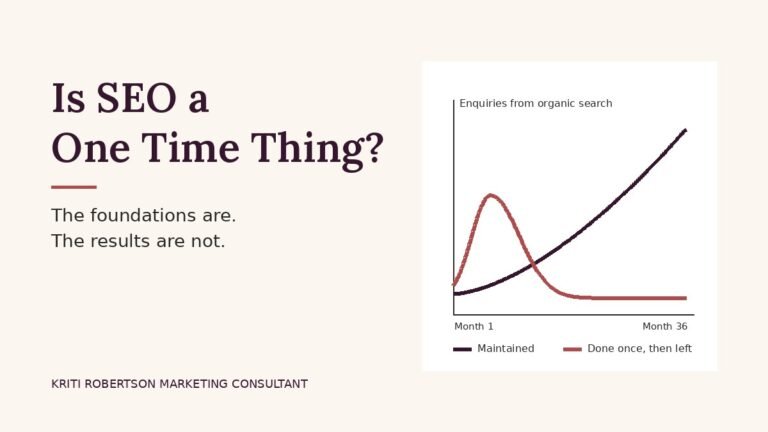
Is SEO a one time thing? I hear this question in two different voices. The first is hopeful: a founder who has just paid for a new website and wants to know if the “SEO included” line on the invoice means the job is done. The second is tired: a business owner who has paid an agency a monthly retainer for 18 months, cannot tell what changed, and is wondering whether they should have paid once and walked away.
Both deserve a straight answer, so here it is. Parts of SEO are one time. The parts that actually produce revenue are not. The useful question is not whether SEO is a one time thing, but which parts you pay for once, which parts you keep paying for, and how you tell the difference before you sign anything.
The short answer
No, SEO is not a one time thing. But it is also not the open-ended monthly subscription most agencies sell. The honest shape is this: a concentrated fix at the start, then a lighter maintenance rhythm that compounds, then occasional sprints when something changes in your business or in Google. If a provider cannot describe which of those three phases you are in and why, you are not buying SEO. You are buying a line item.
I run Kriti Robertson Marketing Consultant (KRMC) as a one-woman consultancy, and SEO is one of the three channels I take ownership of. I have seen one-off SEO fixes that paid for themselves for years and monthly retainers that produced nothing but a PDF. The difference was never the billing model. It was whether the work matched where the business was.
Why people believe SEO is a one time thing
The belief comes from how SEO is sold. Web developers bundle “on-page SEO” into a site build, which usually means filling in title tags and installing a plugin. Freelancers sell “SEO audits” as a product with a start and an end. Some SEO packages for small business owners are priced as a single project because that is easier to buy. None of this is dishonest. It just describes the set-up phase and quietly skips the part that follows.
There is a second reason, and it is more uncomfortable. A lot of ongoing SEO retainers genuinely are theatre. A junior account manager sends a monthly report with rankings, impressions and a green arrow. Nothing in the report ties to enquiries or revenue. After a year of that, a sensible founder concludes that the ongoing part is a scam and the one-time part is the only thing that was real. I understand the conclusion. I just think it draws the wrong lesson. The problem was the retainer, not the idea of continuity.
What genuinely is one time
Some of the work does get done once, and done properly it stays done for a long time. In that narrow sense, SEO is a one time thing. I would put these in that category:
Site architecture: a sensible URL structure, one page per intent, no duplicate pages competing with each other. Technical foundations: crawlability, indexing, page speed, mobile layout, schema markup. Keyword mapping: deciding which page on your site is responsible for which search intent, so you are not writing the same blog post four times. Google Business Profile set-up: correct category, services, attributes, service areas and a description that uses the words customers actually search.
This is the “Fix” phase. On most sites I take on, it takes four to eight weeks and it is the highest-return work I do, because everything built afterwards sits on top of it. If you are a bootstrapped local operator with a limited budget and you can only afford one engagement, this is the one to buy. It is exactly why I built the Local SEO Sprint as a fixed-fee, 14-day intensive rather than a retainer. A brick-and-mortar business does not need a 40-page strategy. It needs the foundations fixed, fast, by someone who knows what they are doing.
But even the one-time work has a shelf life, and that is where the answer to “is SEO a one time thing” starts to fall apart.
What keeps moving: Google changed Search 4,781 times in one year
Here is the number I share with every client who asks whether SEO can be finished. According to Google’s own How Search Works page, in 2023 the company ran 719,326 search quality tests and 16,871 live traffic experiments, which resulted in 4,781 launches. That is more than 13 changes to Search every day of the year.
Most of those changes are small. You will not notice them individually. But they accumulate, and roughly every quarter one of them is large enough to move entire industries up or down. A page optimised perfectly in January is optimised for a version of Google that no longer exists by December. That alone settles whether SEO is a one time thing. It is not a reason to panic every time an update is announced, though. It is a reason to check your core pages against real data a few times a year and adjust the ones that have slipped.
The other thing that keeps moving is your market. Competitors publish. Customers change the words they use. A new question starts appearing in your enquiries that your site has no page for. SEO is a response to search demand, and search demand does not sit still. Treating SEO as a one time thing simply means your SEO stopped responding.
What compounds: the pages that rank are old, and they were maintained
The second piece of research cuts the other way, and I think it is the more persuasive one. In a May 2025 study, Ahrefs looked at how long it takes pages to rank and how old the top-ranking pages are. Only 1.74% of newly published pages reached Google’s top 10 within a year. Of the pages that do sit in the top 10, 72.9% are more than three years old, up from 59% when Ahrefs ran the same study in 2017. The average page ranking number one is now five years old.
Read that carefully, because it is often misread. It does not say “publish once and wait five years.” The pages that survive five years at the top are the ones that were kept accurate, expanded when a new question came up, re-linked from newer content, and trimmed when a section stopped being true. Age is not what ranks them. Accumulated trust is, and trust only accumulates on pages someone keeps looking after.
This is the compounding argument for ongoing SEO, and it is the opposite of the retainer theatre I described earlier. The ongoing work is not “more content every month.” It is protecting and growing the handful of pages that already earn money. I wrote a separate piece on how often to update website content for SEO if you want the cadence I actually use.
The Google Business Profile that scored 26 out of 60
I will give you a real example of what “one and done” looks like in practice. I scored a client’s Google Business Profile recently. Their reviews came out at four out of five on my scorecard: genuinely excellent, high volume, strong ratings. Then I scored the rest of the profile. Wrong primary category. No posts. No products. Photos that were two to six years old. Zero keyword alignment between the description and what customers search. Total score: 26 out of 60.
It is a pattern I see constantly, and it is the clearest answer I have to whether SEO is a one time thing. Business owners assume reviews are the whole game, so they get complacent the moment the reviews look good. But reviews build trust once someone is already looking at you. They do nothing to help someone find you in the first place. The profile had been “set up” years ago, by someone who did it once and never came back, and the business had been quietly losing map pack visibility to competitors with worse reviews and a maintained profile.
That profile took me under two weeks to fix. The fix was one time. The reason it needed fixing was that nobody had treated it as something that needed looking after. Both halves of the answer live in the same example.
What ongoing SEO should look like, and what it should not
If you accept that SEO is not a one time thing, the next question is what you should be paying for after the foundations are built. My rule is simple: ongoing SEO is only worth funding when every hour can be traced to a page, and every page can be traced to a conversion. Here is what that looks like at KRMC.
Monthly, I check the pages that already bring enquiries against Search Console and the CRM, not against a rankings tool. If a page that was producing leads has slipped, I find out why before anything else gets touched.
Quarterly, I revisit the keyword map. New questions from sales calls get a page. Pages that have never converted get merged or removed. Twice a year, I re-run the technical audit, because plugins update, developers push changes, and sites break in ways nobody notices from the front end.
What it should not look like: a fixed quota of blog posts regardless of whether anyone searches for them, a report that leads with impressions, and a monthly call where nothing is decided. I have never celebrated a click in a client report and I am not going to start. If you want to know what good reporting looks like, the case studies on this site show the numbers I actually track.
The broken agency model is what makes ongoing SEO look like a waste. One person owns the technical audit, another owns content, a third owns links, and a junior account manager stitches it into a slide deck. Nobody sees the whole funnel.
As an independent SEO consultant who also runs the paid media and the automation for the same clients, I can see when an SEO change moves the enquiry form and when it only moves a chart. That single view is the whole point of hiring a full stack digital marketing consultant instead of three vendors. I have written before about why marketing strategies must line up with SEO strategies, and this is the practical version of that argument.
How to decide which model you need
Here is how I would think it through if you are asking whether SEO is a one time thing for your business, and deciding whether to buy a one-off project or an ongoing arrangement.
If you are a local service business, have never had the foundations done properly, and your budget is tight, buy the one-off fix. A focused local SEO consultant engagement that fixes the profile, the location pages and the tracking will outperform a vague monthly retainer every time.
Treat it as local SEO for small business owners done once, properly, and then revisit it yourself every quarter with a checklist. Any small business marketing consultant who tells you that you need a 12-month contract before they will touch your Google Business Profile is selling you their cash flow, not your results.
If you are an established business where organic search already drives a meaningful share of pipeline, you need continuity, but you need it from someone accountable for the revenue, not the rankings. That is the work of an organic SEO consultant who is measured on enquiries. For a business at this stage, small business SEO services bought as a fixed monthly quota of deliverables will under-perform a lighter engagement that targets the pages that matter.
If you are somewhere in the middle, the sensible sequence is the one I use on every retainer: Fix, then Focus, then Grow. Fix the foundations in the first two months. Focus on the one search intent the data already proves is converting. Only then grow into new topics. Scaling before fixing is how businesses end up pouring money into a leaky bucket, and it is the single most common mistake I see when a marketing strategy consultant is brought in after the fact to work out why nothing is working.
One more thing worth saying. The maintenance part of SEO gets dramatically cheaper when the reporting is automated. A marketing automation specialist can wire Search Console, analytics and the CRM into one dashboard once, so the monthly check takes 20 minutes instead of a half-day of exporting spreadsheets. That is the kind of one-time work that makes the ongoing work affordable.
The verdict
So, is SEO a one time thing? The foundations are. The results are not. Google made 4,781 changes to Search in a single year, your competitors keep publishing, and the pages that hold the top spots for five years are the ones somebody kept looking after. Pay once for the fix. Pay a little, continuously, for the pages that earn. Refuse to pay for anything in between that cannot show you a conversion.
SEO is not something you finish. It is something you stop neglecting. If you want a second opinion on whether your current arrangement is maintenance or theatre, I will audit your site and your Google Business Profile in week one and tell you exactly which parts are done and which parts have been quietly decaying. As a business marketing consultant who owns the whole funnel, I would rather tell you that you do not need a retainer than sell you one you will resent in six months.