Kriti Robertson is an independent business marketing consultant based in Hong Kong. She works with a small, capped roster of business owners who are tired of agencies that sell tactics before they have a strategy. Her work covers marketing strategy, organic SEO and a 14 day Local SEO Sprint for businesses that need customers now.
What Is Onsite and Offsite SEO? The Split That Decides Where Your Budget Goes
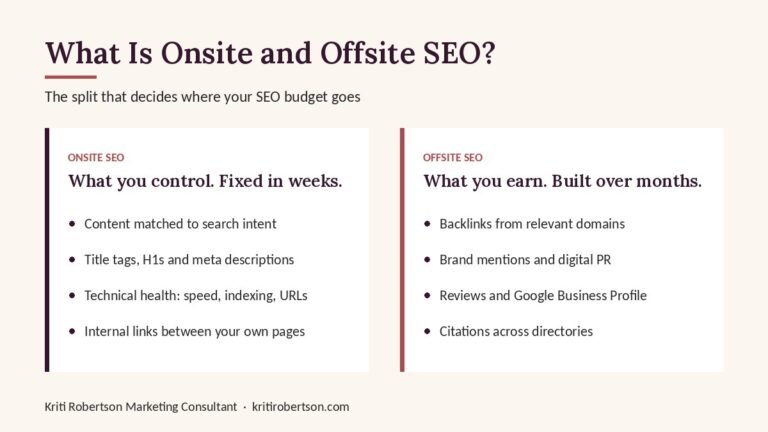
What is onsite and offsite SEO? It is the first question I get from founders who have been paying for “SEO” for a year and cannot tell me what they bought. Onsite SEO is everything you control on your own website: the words on the page, the titles, the structure, the speed, the internal links. Offsite SEO is everything that happens away from your website that tells Google you are worth ranking: links from other sites, mentions, reviews, and your Google Business Profile. One is yours to fix this week. The other is earned over months. That difference is the whole point of understanding the split.
Most agencies blur the two on purpose. If you cannot separate what is onsite from what is offsite, you cannot tell which half of the retainer is working, and a monthly PDF full of rankings keeps you from asking. As a business marketing consultant who runs both halves for a maximum of three retainer clients at a time, I am going to give you the plain split, the data on why each half matters, and the order I do them in.
Onsite SEO: what it covers and why it comes first
Onsite SEO, also called on-page SEO, is the set of signals that live on your domain. In practice it breaks into four areas.
Content and intent
The page has to answer the query the searcher typed, in the format they expect. A service page cannot rank for a research question and a 400-word blog post cannot rank for a buying query that competitors answer with pricing tables and proof. Matching intent is the largest single onsite lever, and it costs nothing but thinking.
Titles, headings and metadata
The title tag, the H1, the H2 structure and the meta description tell Google what the page is about before it reads a word of body copy. They also decide whether anyone clicks. Ahrefs’ title tag study found Google rewrites title tags 33.4% of the time, and when it ignores the title it uses the H1 50.76% of the time instead. That is a reason to make the H1 and title say the same thing in plain language, not a reason to skip them.
Technical health
Crawlability, indexation, page speed, mobile rendering, clean URLs, no duplicate pages competing for the same keyword. None of this ranks you on its own. All of it can stop you from ranking at all. I treat technical onsite SEO as plumbing: nobody notices it until it leaks.
Internal linking
The links between your own pages are the most undervalued onsite signal I see. They pass authority from the pages that have it to the pages that need it and they tell Google which page is the main one for a given topic. On most small business sites the internal links are whatever the menu happens to be, and nothing else.
Offsite SEO: what it covers and what it is really measuring
Offsite SEO, also called off-page SEO, is every signal that sits on someone else’s property. Google uses it as a proxy for trust, because you cannot write your own reference.
Backlinks and referring domains
A link from another website is still the strongest offsite signal there is. What matters is not the raw count but the number of distinct, relevant domains linking to you and whether those pages have authority of their own. Ten links from one directory are one vote. One link from a trade publication your customers actually read is a different thing entirely.
Brand mentions and digital PR
Unlinked mentions, citations in industry roundups, podcast appearances, guest expertise. These build the entity signals that increasingly matter as Google and the AI answer engines decide which brands to cite.
Reviews and local signals
For any business with a physical location or a service area, your Google Business Profile, your review volume and velocity, and your consistency across directories are offsite SEO. They are the version of offsite SEO that moves fastest, which is why, as a local SEO consultant, I built a fixed-fee 14-day sprint around it rather than folding it into a vague retainer.
The data: why neither half works alone
If you only read one statistic this year on this topic, make it this one. Ahrefs analysed roughly 14 billion pages in its December 2023 search traffic study and found that 96.55% of all pages get zero traffic from Google. Of the roughly 20 million pages in that sample with no referring domains at all, only 2,997 earned more than 1,000 search visits a month. That is about one page in every 6,700.
Read that carefully, because both halves of the SEO split are hiding inside it. The pages with no traffic are overwhelmingly pages with no links, which is an offsite problem. But Ahrefs’ own explanation for the 96.55% lists three causes, and two of them are onsite: the page targets a topic nobody searches for, or it does not match the intent of the people who do. A beautifully linked page about the wrong topic earns nothing. A perfectly written page nobody links to earns almost nothing. The retainer that only does one half is selling you a coin with one face.
Which half is your problem? A two-minute diagnosis
I can usually tell within a few minutes of opening Search Console which side of the split a business is losing on. You can do the same.
If your pages are indexed, show impressions for relevant queries, but sit on page two or three for every one of them, you most likely have an offsite problem. Google understands what you are about. It just does not trust you enough yet.
If your pages show impressions for queries that have nothing to do with what you sell, or show almost no impressions at all despite being live for months, you have an onsite problem. Google does not understand what you are about, and no amount of link building will fix a page that targets the wrong thing.
If your rankings are fine but nobody clicks, that is onsite too: the title and meta description are not earning the click. Ahrefs found 25.02% of top-ranking pages do not even have a meta description. That is free traffic left on the table by sites that already did the hard part.
The order I do them in: Fix, Focus, Grow
Clients almost always want to talk about scaling first: more content, more links, more channels. I structure every SEO engagement in three deliberate phases instead, and the onsite and offsite split maps onto them cleanly.
Fix is months one and two. That is onsite: tracking, indexation, the catalogue or service pages, intent alignment, the internal link structure. Focus is months two to four: own the one search intent the data already proves is converting, which means building the best page on the web for it and then pointing offsite effort at that page specifically. Only then do we Grow, which is when broader link acquisition and digital PR earn their keep, because now every link lands on a page that can convert the visitor it brings.
I will not propose offsite work before onsite is fixed, and I say that plainly in week one. Buying links for a site with duplicate titles and a 6-second load time is paying to send guests to a house with no front door.
Where the agency model breaks the split
Here is the structural reason founders arrive at my door confused about what is onsite and offsite SEO. At most agencies these are two different departments. The content team writes the pages. The link building team, often a subcontractor, buys or earns the links. A junior account manager sits between them and compiles a report that shows rankings going up and to the right, which, for enough keywords, they always will.
Nobody in that chain owns the question that matters: did the links land on the pages that convert, and did the pages that convert get the links? That question only gets answered when one senior person is looking at both halves and the pipeline numbers at the same time. It is the reason Kriti Robertson Marketing Consultant is set up as a consultancy and not an agency. When you hire KRMC, the person auditing your onsite structure is the same independent SEO consultant deciding which three pages deserve offsite effort this quarter, and the same person checking whether enquiries went up as a result.
The offsite signal small businesses ignore most
I will give you one example from my own audits, because it shows how misunderstood the offsite half is for local businesses.
I scored a client’s Google Business Profile against a 60-point checklist. Their reviews came out excellent: high volume, strong ratings, four out of five on that section. Then I scored the rest of the profile. Wrong primary category. No posts. No products or services listed. Photos between two and six years old. Zero keyword alignment between the profile and the services they actually wanted to be found for. Total score: 26 out of 60.
It is a pattern I see constantly. Business owners assume reviews are the whole offsite game, so they get complacent the moment the star rating looks good. Reviews build trust once someone is already looking at you. They do nothing to help someone find you in the first place. That is the job of the category, the services, the photos and the keyword alignment, and it is why local SEO for small business is the fastest-paying version of offsite SEO I know. The profile is an asset you control almost completely, sitting on a property Google trusts completely.
What this means for your budget
Once you understand the split, the budget conversation gets simpler.
Onsite SEO is mostly a one-time investment with ongoing maintenance. The audit, the restructure, the rewrite of core pages and the technical fixes happen once and then need checking quarterly. If a provider is charging you a large monthly retainer and the deliverable is still “on-page optimisation” in month nine, ask what exactly is being optimised.
Offsite SEO is an ongoing cost by nature, because links and mentions are earned over time and competitors keep earning theirs. It is also the half where money gets wasted fastest, because it is easy to buy volume that does nothing. Judge offsite spend by one number: did the pages that received links move in rankings and, more importantly, in leads. If the report cannot connect the two, the report is theatre.
For a bootstrapped local operator, the right first spend is almost always the Google Business Profile and the core service pages, not a link building package. For an established founder with a working funnel, the right spend is usually the opposite: the onsite is roughly fine and the ceiling is authority. Any honest organic SEO consultant will tell you which one you are before taking the money, and if the answer is “both, equally, forever”, that is a sales script, not a diagnosis.
How onsite and offsite SEO fit the rest of your marketing
SEO does not sit in a silo, however much the agency org chart says otherwise. The intent research you do for onsite SEO is the same research that tells you which Meta ad angles will convert. The pages you strengthen for offsite effort are the same pages your ads should land on. The reviews you earn for local SEO are the same proof you should be putting in your email sequences.
That is why I run SEO inside a full system rather than as a standalone line item. A marketing strategy consultant who cannot read a crawl report, or an SEO specialist who has never seen your cost per lead, will each optimise their own half and miss the business. The founders I work with have usually been through two or three of those specialists already, each with a different definition of success, before deciding they want one full stack digital marketing consultant accountable for the whole funnel. Whether you are a SaaS brand that needs a saas marketing consultant’s view of trial signups or a shop that needs an ecommerce SEO consultant’s view of category pages, the split is the same. Onsite earns the right to rank. Offsite earns the rank.
What is onsite and offsite SEO? The short version
What is onsite and offsite SEO? Onsite is what you say about yourself on your own site, and you can fix it in weeks. Offsite is what the rest of the web says about you, and you earn it over months. Google needs both: the Ahrefs data shows pages with no links almost never get traffic, and pages that target the wrong intent get none even with links. Diagnose which half you are losing on before you spend. Fix onsite first, point offsite effort at the pages that already convert, and judge every dollar of it by leads, not rankings.
If you want one person to own both halves and tell you plainly which one is leaking, that is what I do. I will audit your funnel in week one and tell you exactly where the leaks are. The small business SEO services page explains how the retainer works, and if you are a local operator who needs the fastest offsite win first, the Local SEO Sprint takes four businesses a month and finishes in 14 days.